We study the state of the modern global microelectronics market, key drivers and development prospects, as well as the impact of the main trends in the industry using the example of the development plans of the largest microelectronics manufacturers
Microelectronics is one of the fundamental industries for the technological development of the economy. The most significant areas of use of microelectronic components are telecommunications, computing, transport, industry, and consumer devices.
The wide applicability of the industry’s products determines its long-term growth. From 2020 to 2024, the microelectronics market grew at an average annual rate of 9% . At the same time, while demonstrating sustainable expansion in the long term, it is subject to local declines. In 2023, there was a decrease in the volume of microelectronics consumption against the backdrop of a decrease in demand in a number of industries, primarily from consumer devices.
Dynamics and structure of the global microelectronics market, billion US dollars (Photo: SIA, WSTS, SEMI, analysis by Strategy Partners)
In 2024, the market recovered and reached $627 billion , with the key growth driver being the increased consumption of video cards and processors for artificial intelligence (AI) used to create data centers (DPCs). The main sectors consuming microelectronics products are computing equipment and telecommunications: they account for 58% of the market .
Demand-side trends and forecast of microelectronics consumption volume
In the long term, demand for the industry’s products will grow as digitalization develops and new technologies are applied. As part of our analytical special project for the upcoming Microelectronics forum, it was established that the main factor stimulating the growth of demand for microelectronic components is the active development of a number of key technologies:
AI;
cloud computing: a high proportion of computing is moving to the cloud, with the number of servers and data centers growing;
development of telecommunications: growth in the number of devices and network speeds, modernization of communications infrastructure;
new technologies in the transport industry: growth of the electric and hybrid vehicle segment, introduction of driverless driving systems and advanced driver assistance systems (ADAS);
Edge computing: the growth of small data centers located at the edge of the network;
growing demand for power electronics due to rising energy consumption: general digitalization, increasing number of electric vehicles and data centers;
Cybersecurity: Complex security methods require more microelectronics for encryption;
Industry 4.0: automation of production through the introduction of digital equipment and the Industrial Internet of Things (IIoT).
As a result of the development of these areas , it is predicted that the volume of demand for microelectronics products will grow at a rate of 8% to $1 trillion in 2030. The largest share of the growth of the global microelectronics market will be provided by two industries: computing equipment and telecommunications equipment. The total share of these industries in the consumption structure will grow from 58% in 2024 to 65% in 2030 .
Supply-side trends
The microelectronics market is global in nature, with distinct regional specialization in individual production processes. The emergence and deepening of specialization at individual stages of chip creation is due to the capital intensity and complexity of the production process. The microelectronics market is characterized by high consolidation: 56% of its volume is controlled by ten leading companies from the United States, the Republic of Korea, and Germany. According to the results of 2024, the top three leaders in terms of revenue from sales of microelectronics products were Samsung Electronics, Intel, and Nvidia. Nvidia’s capitalization reached $4 trillion in July 2025 , overtaking Apple and Microsoft and becoming the most expensive company in the world.
The bulk of the supply is provided by a pool of six countries/regions: the United States, the European Union, South Korea, Japan, Taiwan, and China. The United States is a leader in both chip development and production. The development and implementation of new technologies in the field of microelectronics is carried out in the above countries/regions under the auspices of state implementation centers with large-scale state funding.
Structure of the global microelectronics market by production processes, % of revenue of companies in the segment, % of added value (Photo: BCG, SIA)
The key trend in the development of the production base in the field of microelectronics is sovereignty. Against the background of a high level of geographical concentration – geopolitical tension (which is expressed in the strengthening of trade restrictions and the intensification of armed conflicts), the possibility of pandemics or natural disasters – there are significant risks of failure of logistics chains. This dictates the need to develop full-cycle production within individual countries/regions. The effect of this trend is manifested in all leading manufacturing countries: they are implementing development programs and introducing market protection mechanisms.
Currently, the leaders in terms of production capacity are China, Taiwan and South Korea, the total share of these countries in the global capacity is more than 60%. The largest construction of new factories on the horizon of 2024-2032 is planned in Taiwan, the USA and South Korea, which should ensure an increase in production capacity in these countries within the specified period by 97, 203 and 129%, respectively.
All development programs implemented by leading countries in the industry cover priority areas of technological development: the transition to smaller topologies and new packaging methods, the use of new materials, the use of photonic components, research in the field of quantum computing, and the creation of new transistor architectures.
In addition to the leading countries, development programs are being implemented in a number of other countries. The largest investments among them are being made in India. A number of projects are being implemented here to create production facilities in partnership with world industry leaders: Micron, AMD, etc. Against the backdrop of the growing confrontation between the US and China, India may become the “second China” in the field of microelectronics production.
Microelectronics production facilities
The market for equipment and technologies in the field of microelectronics remains highly concentrated, with the key players being the US, EU and Japan. These countries account for 96% of global equipment production. The highest concentration is observed in the lithography and photoresist production segments, with individual countries accounting for approximately 90% of production (the leader in lithograph production is Holland, and in photoresist production, Japan).
As for the relatively small segments in terms of share in the value chain – EDA, IP cores – here the three countries mentioned hold almost 100% of production with a significant predominance of US companies.
The trend towards sovereignty that is characteristic of the microelectronics industry also covers the equipment and technology market. The most striking example illustrating this trend is China. As of 2022 , mainland China accounted for 20% of global equipment spending and 18% of global equipment imports. Due to export restrictions by the United States, Japan and the Netherlands, there is a need to develop domestically produced alternatives. To ensure technological independence in this area, China invested $25 billion in microelectronics equipment in the first half of 2024, with the total volume estimated for last year at about $50 billion . However, despite the implementation of an ambitious development program in 2012-2024, China is still behind in the technological development race in microelectronics.
Cases of leading companies
Key trends in the industry’s development directly affect the plans of manufacturing companies. At the same time, the largest suppliers of microelectronics not only respond to emerging trends, but also set the direction of the industry’s development.
Samsung, one of the leading manufacturers of microelectronics, focuses on development in the following areas:
increasing production of DRAM memory intended for AI accelerators;
expansion of the product line for the automotive industry (the company is implementing a roadmap for the period up to 2027 for the release of eMRAM for use in vehicles);
Together with another South Korean microelectronics maker, SK Hynix, the company plans to spend more than $470 billion to create a chip manufacturing cluster to achieve technological sovereignty.
The development directions of another participant in the top 3 microelectronics manufacturers, Intel, are also based on key industry trends:
focusing on AI in the development of new processors (most of the company’s developments presented at the Consumer Electronics Show (CES) 2025 are aimed at working with advanced language models and increasing the speed of AI-related operations);
Intel is aggressively building factories in the US under a strategy known as IDM 2.0 , which helps protect against supply chain disruptions.
NVidia, also one of the top 3 microelectronics manufacturers, presented the company’s plans for the future up to 2028 at the Computex 2025 and CES 2025 exhibitions. The key development areas for the coming years will be:
The company is building its own data centers. NVidia is moving from supplying equipment to data center operators to designing and building new computing facilities. This is being implemented through partnerships with TSMC, Foxconn, Gigabyte, Asus, and others.
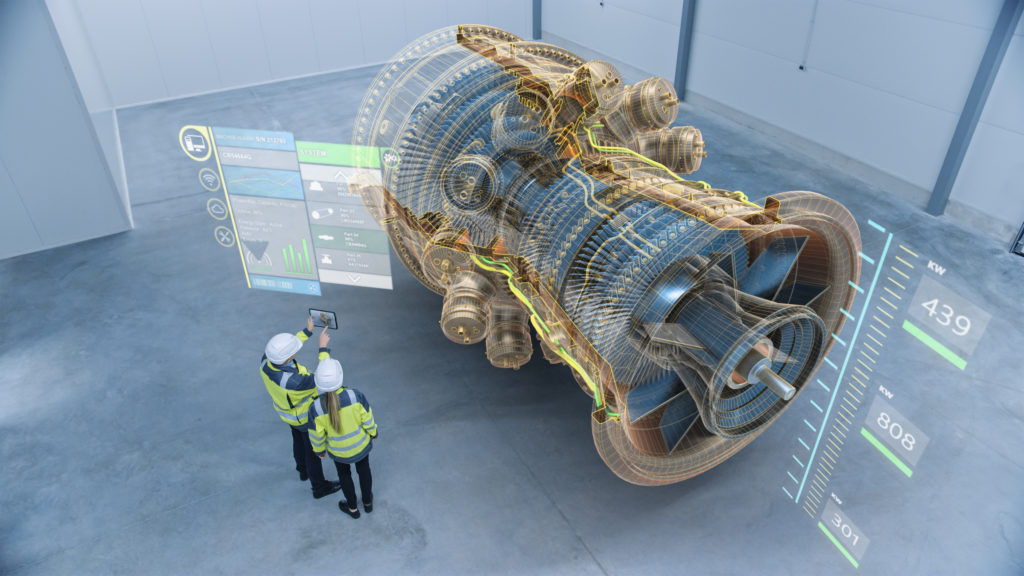
Industry 4.0 developments: development of robotics and digital twins. An example of a project in this area is the creation of a digital twin of a new car manufacturing plant created by NVidia in partnership with BMW. The digital twin allows for modeling, testing and optimizing production processes before the plant itself is launched. The project aims to reduce the time it takes to create real production, as well as to increase the efficiency of production processes.
Developments in the field of autonomous transport and ADAS. NVidia is developing a number of projects in partnership with industry leaders: Toyota, General Motors and others.
Finland’s capital is far from being a huge, over-the-top metropolis. On a human scale, it combines the authenticity of a province with the activity of a big city. Nature is omnipresent with hundreds of parks. Add to this the seaside location and a continent that stretches into the water into some 300 islands. So, whatever the season, you’ll find what you’re looking for on a trip to Helsinki .
On the one hand, you visit Helsinki in winter for its snow-covered islands, its picturesque little Finnish cabins and its Christmas markets . But also to go ice skating among the pastel monuments lit up with little garlands or to cross the city in the snow and reach a cozy café or a trendy sauna. On the other hand, discovering Helsinki in summer is the promise of long days until the midnight sun to stroll on the beaches and walk from island to island. And finally, summer and winter, the capital of the North offers a great cultural diversity: museums, Finnish design galleries, music concerts and opera, remarkable architecture including some notable churches to see.
How to visit Helsinki on a trip, what to do?
Helsinki is very easy to get to, only a 3-hour flight from France. A perfect city for a romantic weekend or a few days with the family. I visited this trading port on the Gulf of Finland in December without snow. But still, I wasn’t disappointed, so I imagine Helsinki all white with snowflakes; it must be exceptional. Here is the list of the best things to do and see without worrying about the season. Except, of course, for the Christmas markets and ice skating, which are only held for a short period in winter.
Visit the heart of Helsinki
Enter the very photogenic Kansalliskirjasto
Go to the most Instagrammable café in Helsinki
Why visit the new Helsinki library?
Where is the Finnish Design District?
Where to see Helsinki’s pretty pastel buildings?
Which sauna in Helsinki?
Which islands to see in Helsinki?
Where to find nice little beaches in Helsinki?
Don’t miss a famous monument in the Finnish capital
Visit an original and refined museum in Helsinki
Tour the city by tram
Stroll along Helsinki’s most popular esplanade
Go to the Helsinki ice rink in winter
Make an art museum in Helsinki
An unusual visit to Helsinki: The Taivallahti
See artist exhibitions in Helsinki
Where is the red brick Uspenski Cathedral located?
Where to go near Helsinki?
What to do during short winter days?
Eating under cover on a rainy day in Helsinki
Visit Helsinki in winter or summer?
Go to Finnish Lapland
1 – Visit the city center of Helsinki on foot
As I said above, the capital of Finland is not very big compared to other metropolises in the world. It is therefore quite possible to explore the different districts on foot. But everything will depend on where you sleep to be more or less mobile. In my case, I stayed in the city center of Helsinki , which allowed me to return to my hotel room to take a break and change for the evening for example. And this is not negligible when visiting a city, any traveler knows it.
However, the tram network crisscrosses the city, and you can reach Helsinki’s right bank from the left bank in just a few minutes. Alternatively, for the more curious who want to explore more than just the city center, there are regular buses.
And visit the oldest district of Helsinki , Kruununhaka . There you will find restaurants, cafes, antique shops, an elegant district where life is good.
Tip for visiting Helsinki: the Helsinki Pass
You’ll discover the city with certain advantages, taking advantage of free public transport, having easy access to museums and monuments and discounts on restaurants and shops. Choose a
2 – enter the old Finnish library in the capital
The National Library of Finland has a beautiful and photogenic architecture. You’ll find it on maps under the name Kansalliskirjasto National Library of Finland . The ceiling with its glass dome lets in beautiful light and the series of Corinthian columns takes you back to distant times. On the other hand, old books with leather covers color the shelves and even if computers have replaced sheets of paper, the whole remains very charming. The National Library is located on the main Senate Square and admission is free. Be respectful of the place, students come here to work.
And further down, in a different spirit, I tell you about the visit to the new Oodi library in Helsinki . A visit to Helsinki that you absolutely must plan .
3 – Go eat a donut at Café Regatta
The lovely gourmet outing will take place at Café Regatta , without a doubt the most Instagrammable of Finnish cafés . This small, typical red hut located at the water’s edge does not go unnoticed. People come here to enjoy a hot chocolate or a large whipped cream coffee with the famous donut . For those who like something savory, you can sit on the outdoor terrace and enjoy sausages grilled over a wood fire . Who hasn’t dreamed of being a trapper one day ? At Regatta Café, you completely believe it between the sea view, the traditional wooden house and the flames of the fireplace.
Very easy to access, the Regatta café is located right next to the Sibelius Monument . Two must-sees on your trip to Helsinki.
4 – take a tour of the huge central library of Helsinki: Keskustakirjasto Oodi
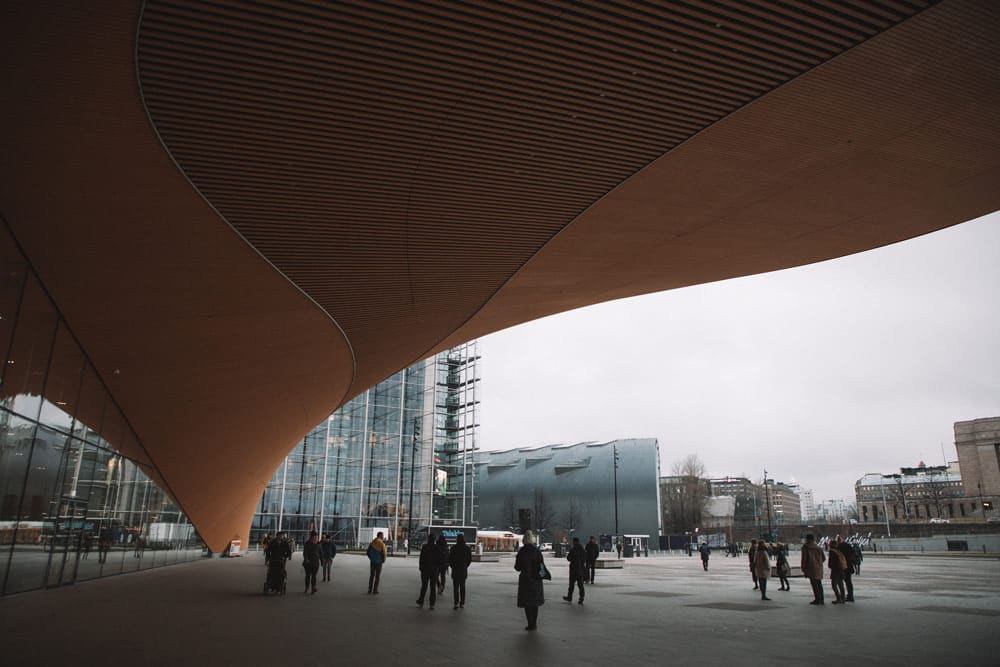
Much more than a library, Oodi in Helsinki is a cultural space articulated around several axes: literary, digital and community. It is located in the Kluuvi district next to the Kiasma Museum of Contemporary Art . From the entrance, we understand that the library of the Finnish capital is going to surprise us.
The Oodi library and its designer architecture
The main façade protects the forecourt like a giant wooden wave. The architect has created a grandiose monument , and the interior is no exception. The building spreads out more than it rises, offering perspectives unlike any other. Here, we find all the Finnish attention to detail and a particular sensitivity to aesthetics and refined design. The spiral staircase seems to hypnotically draw us upward. Finally, the top floor of the Helsinki Central Library is the highlight of the show. Its immense white ceiling with organic shapes brings in more light than the winter days outside. It’s a soothing and open environment that encourages reading.
Living at the same pace as Helsinkians
Reading is one of the main activities of the Finns .
It’s understandable that this library has become one of the city’s most popular places for residents. On Friday afternoons, children are free of school, and many of them head to the digital floor where they have unlimited internet access and the opportunity to play video games with friends, experience virtual reality, or work on self-service computers. Everything is designed to facilitate learning in a fun way.
The top floor is where you come to read and relax in the warmth of a light comparable to a beautiful sunny day.
On the ground floor there is even a self-service restaurant.
5 – Discover the Finnish design district and art galleries
You can’t come to Finland without visiting a few Finnish design boutiques . And of course, the capital has its own design districts where shops and galleries gather. Helsinki’s design district, for example, extends over several neighborhoods: Kaartinkaupunki , Punavuori , Kruunuhaka , Kamppi , and Ullanlinna .
I was able to quickly pass by some promising shop windows. Also, for design enthusiasts, go read this article on the Finnish design districts in Helsinki . In the same vein, I regret not having pushed on to the famous colorful street of Art Nouveau buildings.
And know that September celebrates Design Week in Helsinki .
If you love all things vintage, the neighborhood has a street full of thrift stores: La Korkeavuorenkatu.
6 – the prettiest street in Helsinki: the very Instagrammable Huvilakatu
You shouldn’t miss this street, where small, pastel-colored Art Nouveau castles huddle together. The spot is well-known among Instagrammers who love the most beautiful sites in the world’s capitals. Visit it during the day for the colors and, unlike me, return from this trip to Helsinki with a beautiful photo! Huvilakatu is located south of the design district.
7 – Relax in a trendy sauna on the banks of Helsinki
Apparently, saunas are so deeply rooted in Finnish customs that there’s almost one sauna for every two people in Finland. Also, the capital offers saunas on every street corner. But when you come on vacation, you’re looking for something a little more sophisticated. It’s a bit like telling you to go to the local swimming pool; you’d prefer someone to guide you to the best or most original one. So I’ve selected two well-known places for you. But first, I’ll answer some frequently asked questions for those who have never used a sauna in Finland.
What are the practices in a Finnish sauna? Should you get naked in a sauna in Helsinki?
Should you get completely naked in a sauna in Helsinki? Don’t smile, these are the first questions every good French person asks. No, you won’t be forced to come naked to a Finnish sauna . You can wear a towel around your waist or a swimsuit. But many Finns appear completely naked without any complexes. You should know that these steam baths are considered places of physical and mental purification. There is great respect inside the saunas. You don’t come to the sauna to flirt like you would go to the local bar, far from it. And besides, it’s not a laughing matter in the Nordic countries.
So grab your towels, or don’t, sauna bathing is almost a national sport in Finland. We come to eliminate, clear our minds, and recharge through the real benefits of this moment of relaxation.
Where to find an authentic Finnish sauna in Helsinki during the holidays?
Anyone planning a trip to Helsinki can’t miss a relaxing sauna experience. So, which sauna should you choose for your Helsinki vacation? Here are two places I recommend:
Löyly Public Sauna : A seaside sauna for diving into the Baltic Sea amidst the ice. What better way to experience a sauna experience than by immersing yourself in the icy waters of the Gulf of Finland? Here, you’ll find a classic wood-fired sauna and a smoke-heated sauna to feel good and smell good.
Allas Sea Pool is a sauna café in the heart of the capital. It features several saunas and outdoor pools with a floating dock on Helsinki Harbor. There’s even a leisure center. It’s a bit of a must-do to come and take a photo on the pontoon in your swimsuit with the sea and the city as a backdrop. I was supposed to go there but had to cut my stay short due to strikes in Paris and some canceled flights. Maybe next time.
And for a sauna experience every evening, choose the Bulevardi Hotel which offers rooms with sauna.
8 – Escape to an island in Helsinki
Apparently, more than 300 islands border the city of Helsinki. A pretty string of islands offers plenty of opportunities to visit them, accessible by boat in the summer, but also on foot for some , and on skates for others in the winter.
– Go to the most famous island of Helsinki: Suomenlinna
The most famous is undoubtedly the fortress island of Suomenlinna . It can be visited all year round because it is very close to the south of the city. There are fortifications and a beautiful view of Helsinki. It is also the least wild of all since it is very touristy.
– Explore the island of a thousand Finnish cabins
When traveling, I like to alternate city visits with pure nature moments. On this trip to Finland, I really enjoyed reaching Seurasaari Island , just 15 minutes from the center of Helsinki. To get there, I took the city bus and crossed the small pedestrian bridge. Really simple.
– Take a boat trip in Helsinki
The Helsinki Canal can be visited by boat, a small cruise where you can discover the Finnish coast . This boat trip will reveal some of the famous islands of Helsinki including the Suomenlinna fortress. Thus, exploring the archipelago by sea can be done on a panoramic cruise over half a day or a day. Also, an opportunity to see a little more of the country and fall in love with the Helsinki coastline. Without forgetting to see the icebreaker fleet up close. Note that on this trip, a small cafeteria is held on board. Inquire at the Tourist Office for any reservation, discount or free with the Helsinki Card .
9 – Which beaches in Helsinki? Where to swim?
Swimming in Helsinki in summer
But yes, you’re not dreaming, there are beaches in Helsinki despite the winter image we have of this part of the world. The eastern part of the city is dedicated to the port and ferry entrances, while you’ll find more welcoming shores on the western side.
First of all, the most famous, towards Hietaniemi , Hietaranta Beach , located not far from the Regatta café .
On the almost island of Lauttasaari there is the small beach Kasinonranta .
Furthermore, the islands offer pleasant seaside locations, particularly with the two beaches on Seurasaari Island , which remains the wildest and closest to the city center.
To the northeast, you reach a strip of sand on the island of Mustikkamaan .
Swimming in Helsinki all year round
And finally, against all odds, you can swim in the Baltic Sea in winter, even in the bitter cold. To do this, you’ll have to go to a seaside sauna like the Allas Sea Pool sauna restaurant and its large pools on a floating dock. An invigorating bath that’s coming back into fashion among young people eager to improve their physical fitness and lifestyle . Saunas are diversifying and in Finland offer the chance to have a drink and even eat there. Would you be willing to try swimming in ice water? Without going that far, taking a dip after the spa or relaxing in the hot steam is an unforgettable experience! And what’s more, alternating hot and cold has stimulating and beneficial properties for the body.
10 – Street art in Helsinki: the Sibelius Monument
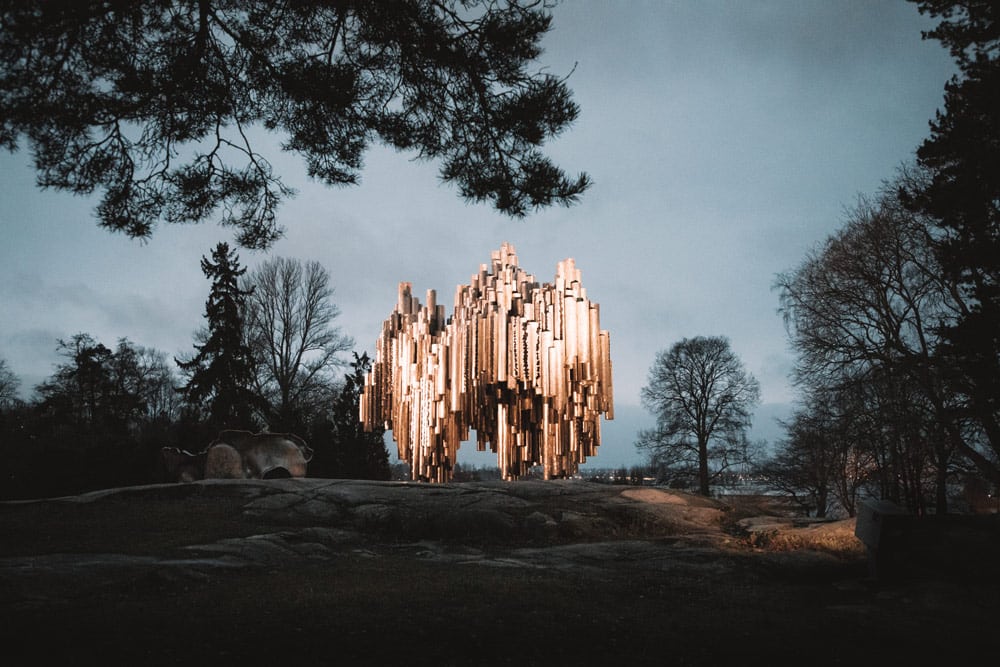
During your trip to Helsinki, explore the city’s artistic universe. A work in memory of Jean Sibelius , a Finnish classical composer who represents Finnish identity well. He marked the 20th century with his 8 symphonies that glorify nature. The Sibelius Monument sculpture represents birch trees, the most abundant tree in Finland. If you are coming by bus, the nearest bus stop that will also serve Seurasaari Island is Rajasaarentie.
11 – Visit the Arabia ceramics and Iittala glass museum: Design Museum Arabia
The Arabia Design Museum exhibits Finland’s most renowned glass and porcelain collections . It also provides an opportunity to explore the history of ceramic and glass design in Finland. Located in Arabianranta, a chic neighborhood in Helsinki.
12 – Take the Tram to tour the Finnish capital
Helsinki’s trams run through the city, bringing life to the streets. If you’re used to taking public transport , it’s very easy to get around, with stops at various major points in the city centre. It’s convenient and enjoyable to live at the same pace as the locals .
13 – Stroll along Helsinki’s most popular esplanade
Senate Square is definitely the place where there’s always something going on in Helsinki. The neoclassical monuments that frame the esplanade are the main reason for this. The Government House, the Lutheran Cathedral, Sederholm House, and the main university building all gather around the square. And seeing Helsinki Cathedral is definitely a must-see on your trip. Many festive events and craft markets are held here. Check according to your vacation dates . A little further down, Kauppatori , the market square of the Finnish capital Helsinki, runs along the quayside overlooking the Baltic Sea.
14 – Go to the ice rink during a trip to Helsinki in winter
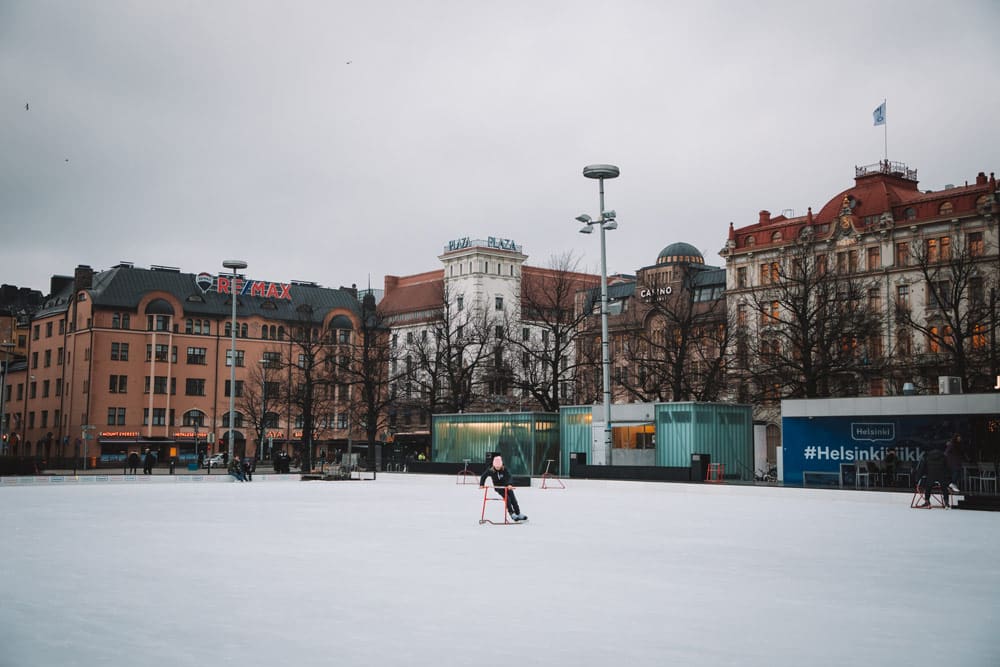
The ice rink at Helsinki Station
Ice skating is a winter activity that requires special conditions . In Helsinki and its surroundings, you can skate in the great outdoors and marvel at the frozen surface of Lake Tuusulanjärvi . Or you can skate on the sea off Vuosaari. In the city center, to practice, the ice rink near Helsinki Central Station is ideal. Another ice rink is near St. John’s Church, in the Punavuori district , or the very popular Brahenkenttä ice rink in Kallio , where you can rent skates.
Skating on the Baltic Sea
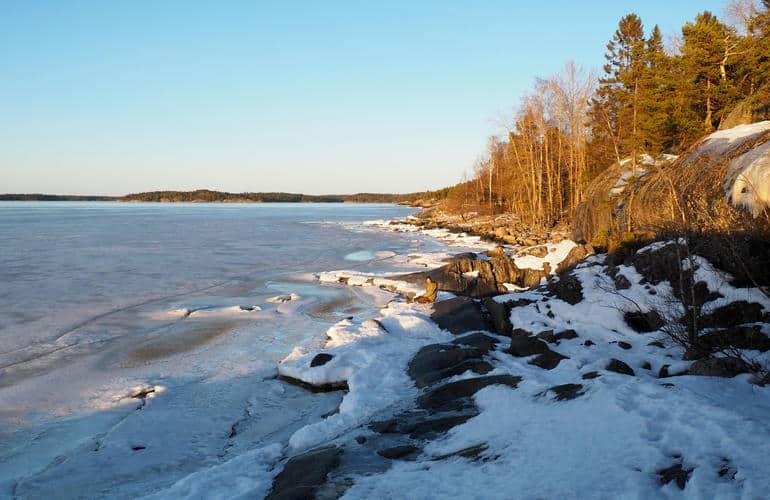
And if you’re lucky in winter and the capital is frozen, go walking on the frozen Baltic Sea , it’s an incredible experience. But don’t leave the marked areas towards the island of Seurasaari from Munkkiniemi . Or the whole area off the Kaivopuisto district . It is possible to do sports activities like snowkiting on Kasinonranta beach in Lauttasaari .
15 – Go to the Kiasma Museum of Contemporary Art
The Kiasma Museum ‘s contemporary art collection spans the period from the 1960s to the present day. The building was designed by American architect Steven Holl.
16 – Unusual architecture in Helsinki: Temppeliaukio Church
Taivallahti Parish Church is an unusual architectural landmark in Helsinki . Temppeliaukio Church was built into the rock in the 1960s and its ceiling is covered with 22 km of copper wire. The seemingly far-fetched idea is to create perfect acoustics. In fact, concerts are often held there.
17 – Art in Helsinki: Kaapeli Space
What if you continued your trip to Helsinki with a unique visit? The Cable Factory, or Kaapeli, is a disused factory repurposed by hundreds of artists. It’s a renowned cultural and artistic center in Helsinki and home to the Free Art School. Artistic events take place within these walls and are reflected in galleries throughout the capital.
18 – The most beautiful monument: the Orthodox Church of Helsinki Uspenski
This Orthodox church is also called Dormition Cathedral , Assumption Cathedral , Ouspensky Cathedral , Ouspenski or Uspenski Cathedral .
Anyway, for the little French girl that I am, this red brick cathedral perched on a rock has a real charm. I recommend you see it during the day if Helsinki is snowy. And at night to see the monument lit by spotlights and the reflections on the water of the harbor with the bridge.
Visit the beautiful red Uspenski Cathedral
The interior is rich in detail and color. A huge chandelier adorns the ceilings, already laden with paintings and moldings. A Byzantine-Slavic style cathedral stands in stark contrast to the austerity of the Romanesque style. Here, one finds the full influence of Russia on Finnish culture.
Tip: For the best view of the cathedral from a slight angle, climb the few steps and walk along the path with the small gate. The perfect angle for a great photo.
19 – Boat from Tallinn to Helsinki
Tallinn is a small, friendly, old city in Estonia. A great opportunity to get away for a day by crossing the Gulf of Finland. The alleys of this medieval city are a veritable labyrinth. The capital of Estonia attracts crowds for its ramparts and the Kiek in de Kök, an artillery tower dating from the 15th century. You can eat in pubs and restaurants that are really cheap compared to the capital. The old town is very lively in the evening, you absolutely have to go for a beer. You can leave Helsinki for 1 or 2 days, it’s enough for a great discovery of Tallinn .
– How long does the crossing between Helsinki and Tallinn take?
To plan your trip to Helsinki, please note that the ferry crossing time from Helsinki to Tallinn is 2 hours.
– How much does it cost to go from Helsinki to Tallinn by boat?
The price for a boat trip from Tallinn to Helsinki is between €10 and €25 per person depending on the date.
– Where to buy ferry tickets to Tallinn from Helsinki?
The most popular company for this Baltic Sea ferry crossing is Tallink Silja Line.
Good to know: Do you need a visa for Estonia? Estonia is part of the Schengen area, so you don’t need a visa to go to Tallinn . An identity card or passport will suffice for a stay of less than 3 months.
20 – What to do at night in Helsinki?
For most of the year, Helsinki has very short days of only a few hours (it’s light from 9 a.m. to 3 p.m. in December), so you might as well know that the Finns didn’t wait for you to find something to do when it gets dark.
Take a walk at night to admire the illuminated monuments including the Uspenski Cathedral. There are also some nice bars on the quays, you’d think you were in Manchester.
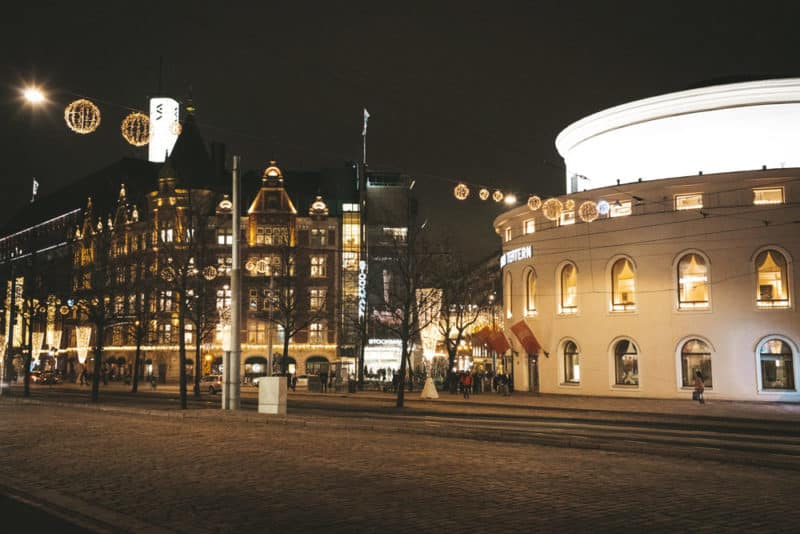
Ice skating between the superb illuminated buildings on the Place de la Gare: the Palais des Etats and the National Theatre.
Go read at the Oodi library
Enjoy the view of the city from the rooftop bar Ateljee Bar .
Where to go out in Helsinki at night? Go out on Thursday nights or weekends to experience Helsinki’s vibrant nightlife. For karaoke, head to Wallis’ Skatta Karaoke Bar or for a cocktail competition at Liberty or Death. Rock fans should head to On the Rocks.
21 – What to do when traveling in the rain in Helsinki?
Rain shouldn’t stop you from visiting Helsinki. Indeed, the capital is often subject to varied weather conditions (sun, rain, snow, ice). It also experiences very short periods of sunshine for several winter months. Therefore, it’s possible to do a lot despite the bad weather in this large northern city.
Eat at the Helsinki Market Hall and shop for some great local produce.
Shop in Europe’s largest department store after Harrods, dating back to 1930. Stockmann is located on one of the busiest streets in Helsinki city center.
Visit the Oodi Library as detailed above.
Take the tram or bus to avoid getting wet.
Make a sauna restaurant.
Visit the city’s museums like the Kiasma or the Arabia Museum that I mentioned before.
Take refuge in one of Helsinki’s many cozy cafes .
22 – Go to Helsinki in winter or summer?
In winter, the first snowfalls begin in the north of the country as early as November. In the southern and central regions of Finland, snow appears in early December and melts in late March or April. This weather in Helsinki will influence your trip. So, which season are you ready to go to Helsinki? Do you choose the gentle pace of life, greenery, and cruises in the archipelago? Or do you opt for snow, the icy sea, saunas, and the Christmas spirit?
23 – Reach Finnish Lapland via Helsinki
After a stopover in Helsinki , you might want to head to Finnish Lapland . Either in winter to discover the Far North under meters of snow like in Christmas stories, or in summer for the midnight sun and long days in nature. To extend your vacation, you will have to take the plane to the capital of Lapland , Rovaniemi . But it is also possible to take a flight to Kittila in the west or Ivalo in the north. I won’t even mention the car because there is a 10-hour journey between Helsinki and Santa Claus Village. Unless you are going on a journey through the Finnish landscapes, then you will certainly make several interesting stops like the city of Tampere .
In any case, I invite you to find more information on Finnish Lapland on these two reference blogs in the field:
Céline from the blog Je Papote offers us her experience of Lapland in all seasons and presents trips organized by her with outdoor activities.
Marion from the blog Mademoiselle Voyage offers tailor-made winter stays and great advice.
Preparing your trip to Helsinki
Where to stay in Helsinki when traveling?
A hotel room with sauna
If you’re looking for an authentic, upscale hotel , I highly recommend the Lapland Hotels chain . The Bulevardi Hotel in Helsinki has rooms with a private sauna. The cozy interior, decorated in wintery tones, immerses you in a typically Finnish world . Wood and wool blend with classic, elegant simplicity. I loved this hotel, which is also very well located in the city center. And the staff is very attentive, a joy to stay here.
Lapland Hotels Bulevardi Bulevardi 28, 00120 Helsinki, Finland
The best part of the accommodation: The glass sauna in the room for lovers.
How to get to the hotel from the airport without a taxi?
Getting to Hotel Bulevardi from the airport by train: First, you’ll take the train as explained at the bottom of this article (about 1 hour). You can also take a tram from the train station to the hotel. It takes about 13 minutes in total. You can use the same ticket you got from the airport train (it’s valid for about 80 minutes). Trams leave right outside the main entrance of the station. Take tram number 3 or 6 (stop number 0302, called “Rautatieasema”). The final direction/destination is “Hietalahti” (tram 6) or “Olympiaterminaali via Eira” (tram 3). Your stop is called “Fredrikinkatu” and it’s the third stop. Continue straight for about 150 m and the hotel should be on your left.
Scandinavian hotel well located in Helsinki
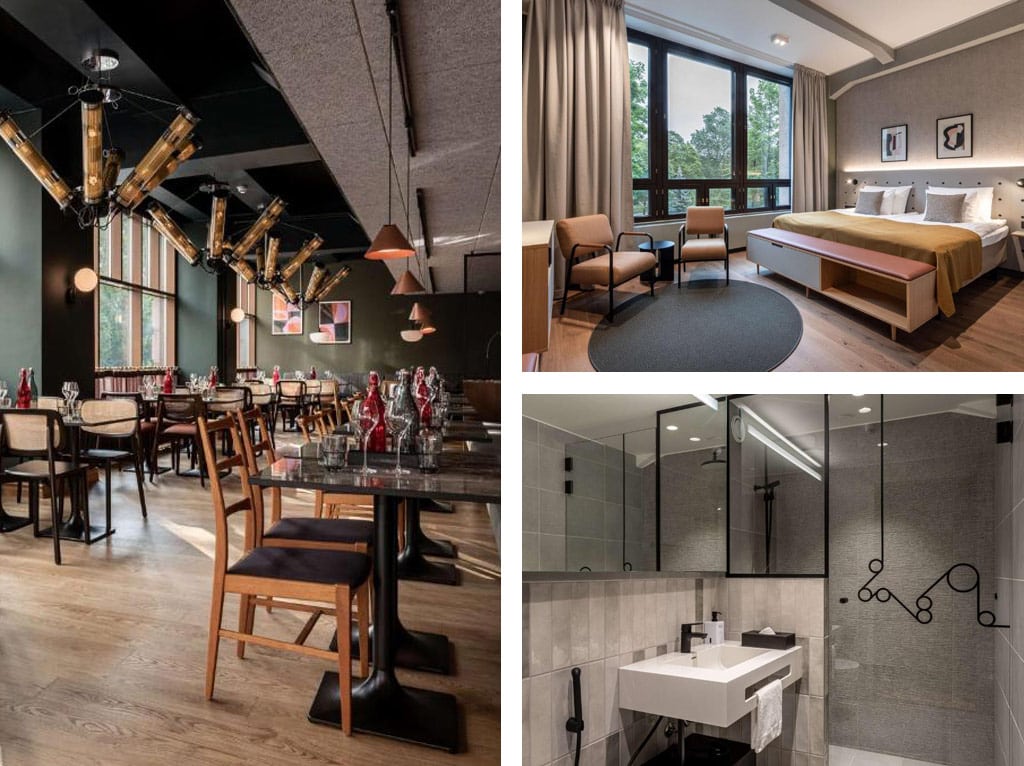
The Scandic Helsinki Hub ‘s designer decor is a reminder of Scandinavian surroundings. The spaciousness of the room and bathroom are a real plus; you feel right at home. This hotel offers excellent value for money, making it one of the best hotels in Helsinki.
The best part about the accommodation: The perfect location, the sauna and the gym to escape the hustle and bustle of the city.
Hotel in the heart of Helsinki city center
Another great hotel for your trip to Helsinki. The F6 Hotel is ideally located for exploring the entire city center on foot. It’s close to the harbor and notable monuments. The room is spacious and the beds are very comfortable.
The hotel’s plus: It meets many essential criteria when visiting a big city.
Among the best hotels in Helsinki
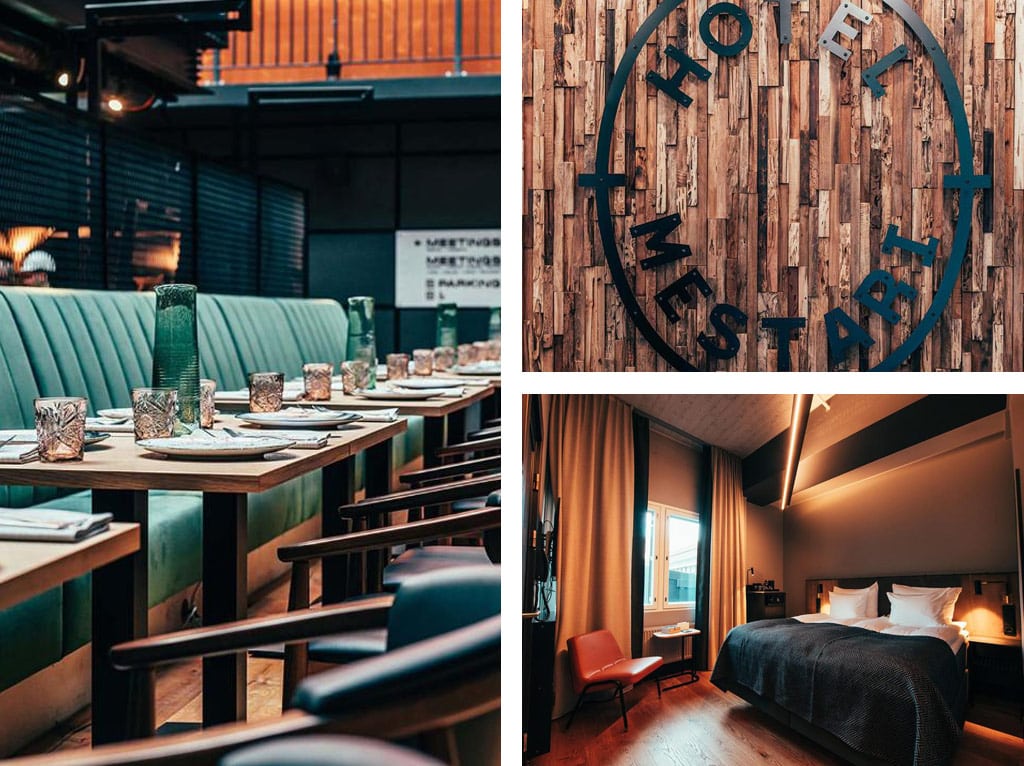
A very nice decor for this hotel really well located in the city center. The staff at the Hotel Mestari Helsinki is attentive and the rooms comfortable.
The best thing about this hotel: Special mention to the bar which offers very good cocktails.
Superb apartments in Helsinki
Idyllic location in the center, a stone’s throw from the Design Museum. The accommodation is very large and bright. The team is attentive and responsive.
The advantage of this accommodation: The very well-equipped apartment allows you to save some money on restaurants during your stay in Helsinki.
Activities and excursions not to be missed when traveling to Helsinki
Helsinki is a lively and cultural city with a variety of excursions and activities to enjoy. As you may have noticed, you can enjoy walks along the Baltic Sea, visit museums and art galleries, explore historical sites, and discover the local culinary scene. Outdoor activities include boat tours, hiking, cycling, and more unusual ones like ice bathing in the Baltic Sea. Here is a selection of the best outdoor activities to do in Helsinki:
I absolutely had to offer you this unusual excursion in the Baltic Sea with a flotation suit . It is an original moment to experience at least once in your life. You can choose to do this activity offshore by boarding a hovercraft, in this case, the winter excursion on the ice is half a day and ends with a barbecue.
To get closer to nature, here is a beautiful, easy walk in the Porkkala archipelago from the center of Helsinki with a guide who will take care of you, preparing a wood fire and a good hot meal for you. Half-day excursion.
Experience a walk through the icy landscapes of Finland’s national park . The highlight of this day trip is a traditional lunch inside a Winter Kota while exploring the great outdoors of Southern Finland.
Where to eat in Helsinki: my favorite places in the city
In a northern capital, there are a lot of very good restaurants but it is always difficult to sort through the reviews on platforms like Tripadvisor. I give you my opinion on the restaurants I was able to visit during my trip to Helsinki, it is subjective but very honest. And as incredible as it may be for the gourmet that I am: I was surprised by the quality of the establishments visited .
When it comes to Finnish culinary specialties , you can’t leave Finland without eating salmon gravlax , reindeer stew , or salmon soup . For lunch, grab a quick bite to eat at the Helsinki Market Hall for some delicious salmon sandwiches. Yes, it’s definitely the most popular dish here.
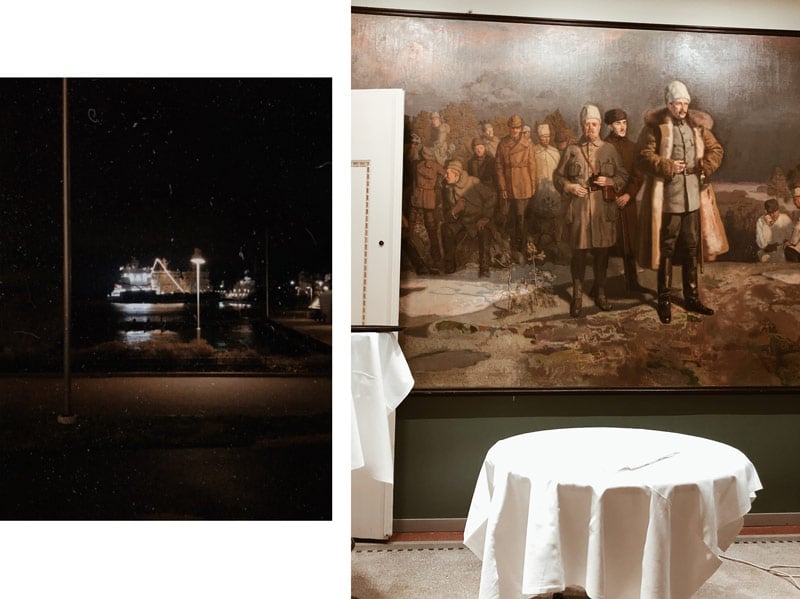
Just across the street from the harbor’s icebreakers, the restaurant is actually the former Naval Officers’ Club . It’s quite strange to find yourself in these large rooms that used to host a completely different type of conversation. The sea view from the windows is pleasant, but it’s on sunny days that you’ll enjoy the terrace and the outdoors.
A high-end yet casual restaurant, the perfect place to eat responsibly while indulging yourself. A must-try experience and a remarkable zero-waste concept. A four-course menu costs €50. And if you’d like to pair your wine with each of your four courses, you’ll have to add €40. Open every evening except Sunday.
On vacation in Finland , I recommend you live at the same pace as the locals by going to a sauna restaurant . A stylish restaurant for dining, saunas and outdoor pools for aperitifs. It’s a ritual for Helsinki students to stop by here for lunch or an evening. And the prices are very reasonable; you can eat for 15 euros at lunchtime.
Young and trendy atmosphere at the Helsinki Shelter
A super trendy restaurant with an exceptional setting, discovered by chance in Helsinki. It’s located on the harbor, just under Uspenski Cathedral, and boasts the same red bricks. The laid-back, boho style of this dock, with the two velvet sofas on the adjacent terrace and the brick facade, gives this restaurant a cool, New York identity. I’m very curious to know more about the cuisine, but their Instagram photos are awakening my taste buds.
What to bring back from a trip to Helsinki?
The capital offers a multitude of shops selling designer and traditional products, and you’ll love them. Here’s a list of what to bring back from a trip to Helsinki and where to shop.
Bring back Arabia Porcelain and Littala glasses (in many shops in the city center)
Buy chocolate with sea buckthorn berries (Finnish sea buckthorn) or reindeer meat from Taiga Chocolate
Bring back something to make glögi (spiced mulled wine) or hot chocolate with Laplandia vodka from the Helsinki Christmas market
Find a multitude of sauna accessories at the Metsä/Skogen concept store on Helsinki’s main street
Bring a fur hat and fur-lined gloves
Bring back the essential hand-carved wooden cup
Look for Finnish honey and homemade jams at the market
Finding a framed aurora borealis
How to dress when traveling to Helsinki in winter?
Going to Finland requires you to ask yourself the question of the appropriate clothing equipment . Especially if you are visiting the capital or other cities in this great Nordic country. Because, even if you were going directly to Lapland, I would tell you to choose a ski outfit and boots . But the mountain look in the city will be a bit of a blot. Okay, I admit that at the slightest snowflake in Helsinki, the children put on their ski suits, but you are an adult so here is my advice.
Clothing for Helsinki in winter : how to dress in Finland?
bring several layers of clothing so you can undress in a restaurant or museum
waterproof, lined high-top shoes (the ones I wore on this trip)
a warm coat
thick, well-insulated gloves
the hat accompanied by the scarf
an umbrella
Don’t worry, it’s still a city, and you can regularly take shelter in a cozy cafe to warm up. If you’ve already been to Prague or any of the northern cities, it’s exactly the same.
Can you see the Northern Lights when traveling to Helsinki?
It’s rarer to see the Northern Lights in Helsinki since the capital is located in the far south of Finland. But there is a more favorable season to observe these solar particles irradiating the sky. This incredible and visually stunning luminous phenomenon is more common in Finnish Lapland . The best time to hope to see the Northern Lights in Helsinki is between September and March. But be careful, in the south of Finland, on average, only 20 nights a year can experience these auroral displays compared to 200 in the north. So, if the sky is clear, keep your eyes open between 6 p.m. and 3 a.m.
Tip for seeing the Northern Lights : A free email alert service warns you of the likelihood of aurora borealis sightings. Log on to the Finnish Meteorological Institute’s website and select “Auroras now!”
Travel to Helsinki: Which flight to Finland from Paris?
There are direct flights from Paris to Helsinki lasting only 2.5 to 3 hours with Finnair.
The airline offers a low-cost meal plan in economy class for a fee. However, it does offer a free drink and snack to tide you over during the flight. However, don’t expect TV or music on board. My opinion of Finnair remains quite positive; the cabin crew was lovely, and it’s good value for money for traveling in Finland .
How to get to the city center from Helsinki Airport easily?
How to get to the city center from Helsinki Airport? There are two trains to take from the airport to Helsinki city center, and this is the most convenient option for you. The I & P commuter trains run directly from the airport to the central station. The first train takes about 10 minutes and the second takes about 40-45 minutes. As this is a regional train, tickets can only be purchased online if you have the HSL app; otherwise, you will need to buy them at the blue ticket machines at the airport. Tickets cost €4.60 per person. There are several destination options per region at the machine. To go to the city, you must choose the “ABC” ticket type.
More information on transport from Helsinki Airport >
Then, from the Central Station, you can take a tram to the station of your choice. Since the train station is already in the city center, it’s only a matter of minutes to reach your hotel or the place you want to visit.
Tip: The ABC train ticket is valid for about 80 minutes. Use it for the city tram to your final destination.
Take out travel insurance for Finland
There are many travel insurances available for exploring Finland and Europe . For this trip, I had forgotten to take out travel insurance and I contacted Chapka Insurance at the last minute. What I appreciate is that they are really fast and efficient.
Do you need a visa for Finland? Please note that a valid national identity card or passport (until the date of departure from the country) is sufficient for citizens of European Union member states.
[You will find some affiliate links in this article. This does not oblige you to buy or reserve, but if you do so through one of them, I earn a small percentage which helps keep this blog alive. So a thousand thanks.]
Together with an expert, we figure out how embeddings work, why they have become the basis of intelligent systems, how they are interconnected with cloud technologies, and what significance they have for the infrastructure of the future
Artificial intelligence can write texts, recognize faces, recommend products, and even predict industrial failures — all thanks to its ability to understand abstract data. At the heart of this ability are embeddings, one of the key tools of machine learning. They allow complex and heterogeneous objects — words, images, products, users — to be translated into digital language that a machine can understand. Without them, AI would be just a set of formulas.
Why AI Needs ‘Digital Translation’
Human language is polysemantic and contextual. When we write “lock,” we can accurately determine whether we are talking about a fortress or a device for locking doors, depending on the context. For a machine, this is a challenge: words, images, events, search queries — all of this must be translated into a numerical format in order to compare, analyze, and train models.
Embeddings are a way to do this translation. A word, image, or other object is represented by a vector — a numerical representation in a multidimensional space, trained on statistical relationships or large language models. These vectors allow the system to determine similarities between objects, build dependencies, and draw conclusions. For example, the embedding of the word “cat” will be closer to “animal” than to “car.”
An example of a 3D projection of embeddings. Although real LLM embeddings cannot be visualized, the principle remains the same – words that are close in meaning are grouped in space (Photo: GitHab)
A 2024 study showed that embeddings obtained using GPT‑3.5 Turbo and BERT AI models significantly improve the quality of text clustering. In the tasks of grouping news or reviews by topics, they allowed increasing cluster purity metrics and improving processing accuracy.
How Embeddings Help AI Understand the World
Embeddings enable neural networks to find connections between objects that are difficult to specify manually. For example, an online store’s recommendation system can determine that users interested in “hiking backpacks” often buy “hiking water filters” — even if these products are not directly related in the catalog. Embeddings capture statistical dependencies, user behavior, contexts, and even stylistic features of the text. This is the key to creating personalized services and scalable intelligent systems.
The main task of embeddings is to transform complex data (text, images, behavior) into a set of numbers, in other words, a vector that is convenient for algorithms to work with. Vectors help AI find similarities, understand meaning, and draw conclusions. Moreover, many things can be represented as embeddings: individual words, entire phrases and sentences, images, sounds, and even user behavior.
Texts and Language (NLP)
It is important for AI not just to “read” the text, but to understand what is behind it. Embeddings allow models to capture hidden connections between words, to determine that, for example, “cat” is closer to “animal” than to “car”. More complex models can create embeddings not only for words, but also for entire sentences – this helps to more accurately analyze the meaning of phrases, which is important, for example, for chatbots or automatic translation systems.
Images and visual content
In computer vision, embeddings allow you to turn an image into a set of features — color, shape, texture, etc. This helps algorithms find similar images, recognize objects, or classify scenes: for example, distinguishing a beach from an office.
Recommender systems and personalization
Modern digital platforms create embeddings not only for content (movies, products), but also for the users themselves. This means that each user’s preferences are also represented as a vector. If your vector is close to another person’s vector, the system can offer you similar content. This approach makes recommendations much more accurate.
How Embeddings Are Created: From Simple to Complex
Embeddings can be thought of as a multidimensional space where each point is an object (word, image, user). The proximity between points in this space reflects the learned similarity. For example, in Word2Vec (an algorithm that turns words into vectors that reflect their meaning and similarity in meaning), the vectors of the words “king” and “queen” will be close, and their difference will be close to the difference between “man” and “woman”. However, in more modern models (e.g., BERT), vectors depend on the context, and such linear dependencies are weaker.
There are different ways in which AI translates text, images, or sound into vectors—aka embeddings.
Classic text models (e.g. Word2Vec or GloVe) create one vector per word. The difficulty is that they do not take into account the context. For example, the word “onion” will mean both a vegetable and a weapon – the model will not understand the difference.
Modern transformer-based models (BERT, GPT, and others) work differently: they analyze the environment in which the word occurs and create a vector that corresponds to this very meaning. This is how AI understands what kind of “bow” we are talking about – green or rifle.
For images, embeddings are built differently. Neural networks trained on huge arrays of images “extract” visual features from them: colors, shapes, textures. Each object in the image is also represented by a vector.
Multimodal embeddings combine data from multiple sources at once — text, images, audio, video — and present them in one common vector space. This allows AI to find connections between different types of data. For example, to recognize that the caption “kitten playing with a ball” refers to a specific moment in a video or a fragment in a photo.
Embeddings are at the heart of recommendation systems, voice assistants, computer vision, search systems, and many other applications. They allow us to find connections between objects, even if these connections are not explicitly stated.
More and more often, attention is paid to adapting embeddings to specific tasks. For example, a model can not just “understand what the text is about,” but form a representation specifically for the desired purpose – be it legal analysis, customer support, or medical expertise. Such approaches are called instruction-tuned and domain-specific.
Where Embeddings Live: Cloud Servers for AI
Training and using embeddings is a resource-intensive process. Especially when billions of parameters and multimodal data are involved. Such tasks require:
a large amount of computing power with GPU resources (specialized graphics processors designed for resource-intensive tasks);
storage of vector databases;
fast indexing and searching for nearby vectors;
low latency in response generation, such as in chatbots and search.
Therefore, the development of embeddings is closely linked to the growing demand for cloud computing and infrastructure optimized for AI workloads. To work with embeddings, businesses need not just virtual machines, but specialized servers with GPU support, high-speed storage, and flexible scalability.
Such cloud solutions allow you to train and retrain your own models, launch services based on LLM, and integrate AI algorithms into websites, applications, and analytical systems. Cloud servers remove the barrier to entry into AI — businesses do not need to invest in their own cluster, they just need to choose the appropriate configuration for their model or service.
Today, embeddings are the basis of search, recommendations, content generation and automation. In the coming years, they will become even more complex, individualized and contextual. AI will increasingly recognize the meaning, goals of the user, the context of interaction – and offer relevant answers. According to analysts , the global artificial intelligence market will grow by about 35% per year and will amount to $1.8 billion by 2030.
But without a reliable infrastructure — fast, scalable, with support for vector databases and GPUs — such systems will be either slow or unavailable. That’s why the development of embeddings and cloud infrastructure go hand in hand: the former provides intelligence, the latter — power and flexibility.
Tech trends for the coming year cover a wide range of areas, such as artificial intelligence, quantum computing, spatial technologies and hardware development. Deloitte analysts have compiled a report highlighting the key trends that will shape technology in the coming year. Komputerra has studied the report and reviewed the key trends in this article.
Artificial intelligence is everywhere
AI is becoming an integral part of life, like electricity or the Internet. By 2025, it is expected to be used in almost every area, from optimizing urban traffic to personalizing healthcare.
Generative models such as large language models (LLM) will continue to evolve, but the focus will shift to using more compact models capable of solving highly specialized problems. Such approaches will provide greater efficiency and resource savings. According to experts, the future belongs to “agent AI”, capable of not only analyzing data, but also performing specific tasks, such as automating business processes, managing supply chains, or creating personalized recommendations for users.
As AI becomes more popular, the need to integrate it into various devices and applications also increases. For example, intelligent assistants will be able to perform complex actions based on the analysis of historical data, which will open up new horizons for automation. Experts note that the development of AI raises issues of ethics and safety that require active attention. Moreover, the integration of AI into everyday life will be accompanied by a change in the labor market: many professions may transform or disappear altogether, giving way to new roles related to the management and development of AI technologies.
Spatial technologies and their integration with AI
Spatial computing is gaining attention due to its ability to merge the physical and digital worlds. It enables new ways to interact with data through 3D models, digital twins, and augmented reality. For example, in the medical field, this will allow doctors to visualize patients’ anatomy in real time, and in construction, to model objects before they are physically built.
The combination of spatial technologies and AI creates the basis for new forms of interaction. Future systems will be able not only to display data, but also to suggest optimal actions based on situational analysis. For example, in logistics, such systems will be able to model delivery routes in real time, taking into account weather conditions, traffic jams, and other factors.
The development of these technologies can also revolutionize education by providing interactive and adaptive learning platforms. Spatial technologies are also becoming particularly relevant in manufacturing processes, where digital twins allow operations to be simulated and optimized before they are actually carried out, saving resources and time.
Hardware comes to the fore
After years of software dominance, hardware is once again becoming a key element of technological innovation. Growing AI demands require specialized computing chips. This is leading to a growing market for AI devices and personal computers with built-in AI chips. Such devices provide autonomous computing, which reduces the load on cloud services and improves data security.
However, this trend comes with challenges in the energy sector: data center energy consumption is expected to increase significantly. To address this, companies are investing heavily in energy-saving technologies such as renewable energy and optimized cooling systems. In addition, a new class of devices is emerging that can perform computations right at the “edge” of the network, minimizing latency and reducing dependence on centralized servers.
In the future, hardware development will go beyond specialized chips. Devices will begin to integrate AI into things like smart home control systems, autonomous cars, and wearables. This will lead to fully autonomous solutions that can adapt to changing environmental conditions.
Quantum Computing and New Approaches to Cryptography
With the advent of quantum computers in the next 5-20 years, current encryption methods may become vulnerable. That’s why companies are already starting to implement post-quantum cryptographic standards. This process takes time, but it cannot be delayed to ensure the security of data and communications in the future.
Quantum computing also opens up new possibilities for data analysis and modeling of complex systems. For example, it could be used to develop new drugs or optimize global logistics networks.
Experts note that companies that start investing in these technologies now will be able to gain a significant competitive advantage. In addition, quantum technologies will be actively used to solve problems that require high-precision calculations, such as financial modeling or predicting climate change.
Digital transformation of core systems
Key enterprise systems are being transformed by AI. Integrating AI into core systems enables automation of routine operations and the creation of more intelligent processes. However, this complicates the architecture of such systems, requiring deep technical expertise and a strategic approach to modernization.
In addition, new technologies help to improve the transparency and usability of such systems. For example, the integration of AI allows for more accurate demand forecasting and resource management. However, it is important to consider that automation should not completely replace human control, especially in critical areas such as healthcare or finance. In parallel, enterprises will be forced to strengthen their cybersecurity efforts to protect updated systems from new threats.
The Power of Technology Intersections
One of the new strategies for innovative development is the combination of different technologies and industries. For example, combining spatial technologies with AI can accelerate the development of solutions for logistics or healthcare. Such targeted intersection opens up new market opportunities and strengthens the competitive advantages of companies.
A striking example is the interaction of AI with robotics. This allows the creation of autonomous systems capable of performing complex tasks, such as collecting data in conditions dangerous to humans. Such technologies can also be used in agricultural technology, helping to optimize crop cultivation processes. Moreover, the integration of technologies in smart city ecosystems will optimize resource management and improve the quality of life of citizens.
Conclusions
In 2025, technology will largely evolve around artificial intelligence, creating smarter, more sustainable, and more intuitive solutions. In addition, spatial computing, new hardware, and preparation for the era of quantum computing are shaping a future in which technology will become even more integrated into our daily lives.
Companies that take action today will not only adapt to new conditions, but also become leaders. Investments in advanced technologies, training specialists and implementing flexible strategies will allow them to use the potential of innovation to the maximum. Successful market players are already paving the way to a sustainable and efficient future, creating products and services that will form the basis of tomorrow’s world.
AI is accelerating digital transformation by providing intelligent solutions for every aspect of life, from text and image to education and customer service. Discover cutting-edge AI tools for text, image, video, audio, translation, and more.
Emerging AI technologies are fundamentally changing the way everyone, from students to data analysts, does business. Intelligent tools used in a wide range of fields, including text production, image and video creation, translation, audio processing, customer service, data analysis, education, coding, and marketing, offer speed, efficiency, and creativity all at once. We compile the best AI applications for various needs, allowing you to easily discover which tools are suitable for each field.
What is Artificial Intelligence?
How Does Artificial Intelligence Work?
What are the Types of Artificial Intelligence?
What are the areas of use of Artificial Intelligence?
Is Artificial Intelligence Dangerous?
Artificial Intelligence Applications
Best AI Apps for Text Generation
Best AI Applications for Generating Images
Best AI Apps for Coding
Best AI Apps for Video Production
Best AI Apps for Audio Processing
Best AI Apps for Translation
Best Applications of AI for Product Design
Best AI Apps for Calendar Management
Best Practices of Artificial Intelligence for Data Analysis and Reporting
Artificial Intelligence Applications Used in Customer Service
Best AI Applications for Education and Learning
Artificial Intelligence Applications for Marketing and Content Optimization
What is Artificial Intelligence?
Artificial intelligence is a discipline used to mimic human-like intelligence and learning capabilities in computer systems. Complex algorithms are programmed to perform specific tasks and make decisions using data analysis and machine learning techniques. Essentially, it aims to provide computer systems with human thinking and decision-making capabilities.
How Does Artificial Intelligence Work?
Artificial intelligence learns by analyzing large amounts of data. This data analysis is combined with machine learning and deep learning techniques to create algorithms. These algorithms process data, identify patterns and relationships, and make predictions about future events.
What are the Types of Artificial Intelligence?
Different types of AI can possess specialized capabilities that differ from other types. AIs capable of classification and prediction can analyze data to classify objects or events into specific categories and predict future outcomes. AIs used in natural language processing can also possess the ability to understand, interpret, and generate human language. AI also has great potential in image and audio processing, capable of performing tasks such as image recognition, voice recognition, or facial recognition.
What are the areas of use of Artificial Intelligence?
The applications of artificial intelligence are extensive and rapidly evolving. In the automotive sector, advanced sensing systems for driverless vehicles enable vehicles to monitor their surroundings and navigate safely. In the healthcare sector, AI plays a significant role in disease diagnosis, medical image analysis, and improving healthcare services. In the finance sector, it is effectively used in areas such as fraud detection, risk analysis, and customer service. Furthermore, in the retail sector, it increases efficiency in processes such as sales forecasting, demand analysis, and customer behavior analysis.
Is Artificial Intelligence Dangerous?
While AI, when developed correctly, is a powerful tool that can make human life easier, uncontrolled or malicious use cases can pose serious risks. Issues such as deepfake technologies, privacy violations, biased algorithms, and workforce transformation, in particular, are sparking debates regarding ethics and security. Therefore, designing it with a transparent, auditable, and human-centered approach is crucial. While technology itself may not be dangerous, how we use it is one of the most critical factors that will determine our future.
Artificial Intelligence Applications
Artificial intelligence has made a significant impact across many industries. It’s expected to become even more widespread in the future. With its data analysis, predictive capabilities, and learning capabilities, it has become a key tool for supporting people and improving business processes. Here are some application examples:
Best AI Apps for Text Generation
Open AI Chat GPT
Chat GPT is an artificial intelligence model created by OpenAI. It can be used to generate conversational text. Based on GPT-4, the model has natural language understanding and response generation capabilities. The application offers more advanced features for a monthly fee and also synchronizes with many search engines.
Anthropic Claude
Developed by Anthropic, an Amazon- and Google-backed AI startup and rival to OpenAI, Claude generates high-quality text using ethical and controlled production methods. It’s a popular alternative to ChatGPT.
InferKit
It offers users the opportunity to create custom text models and produce texts suitable for different use cases.
Copysmith
An AI application that generates various types of text, such as ad copy, blog posts, product descriptions, and more. It can create creative and impactful text.
Best AI Applications for Generating Images
Adobe Sensei
Adobe Sensei, part of Adobe Creative Cloud, uses AI and machine learning technologies to help users design smarter and faster, such as detecting objects within an image, automatically arranging images, or removing imperfections.
Canva
A popular online design tool with a user-friendly interface and AI-powered features. Users can create designs faster and easier with features like AI-powered templates, font suggestions, editing suggestions, and image search.
Pixlr AI
Pixlr AI is a tool that simplifies photo editing and enhancement using artificial intelligence technologies. Users can perform automatic corrections, background removal, color correction, and achieve better results based on AI-provided suggestions.
Photo
Fotor is an AI-powered photo editing app. Users can edit their photos, enhance colors, detect objects in photos, and automatically edit them with AI-based features.
Artisto
Artisto is an AI-powered app that lets you transform photos or videos into unique works of art. For example, you can style photos after famous paintings or animate videos.
Best AI Apps for Coding
GitHub Copilot
Developed in collaboration with OpenAI and GitHub, Copilot offers suggestions and auto-completion based on the code you write. It reduces the workload of developers by quickly solving repetitive tasks.
Amazon CodeWhisperer
Compatible with AWS, the tool offers secure and optimized code recommendations. Developed under the leadership of Jeff Bezos, this AI tool is particularly useful for cloud-based projects.
Tabnine
Tabnine, which offers personalized code recommendations using machine learning, boosts productivity, especially in large teams. This application, which saves time for many developers, supports many languages, including Python, JavaScript, and Java.
Codeium
Offering free, fast, and multilingual support, Codeium stands out with its advanced auto-completion and refactoring features. It makes learning programming languages easier.
Best AI Apps for Video Production
Magisto
Magisto uses AI algorithms to create professional-looking videos by combining your photos and videos. It includes features like automatic editing, adding text, adding music, and applying effects.
Adobe Premiere Pro
Adobe Premiere Pro is professional video editing software that simplifies the video editing process using artificial intelligence technologies. Intelligent tools allow you to perform tasks like automatic color correction, camera motion tracking, audio editing, and even automatic editing.
Animoto
Animoto is a user-friendly AI-powered video creation app. You can upload your photos and videos and create videos using predefined templates and music. An AI algorithm analyzes the content and selects appropriate effects and transitions.
Wibbitz
Wibbitz is a video creation platform that uses AI technology to automatically convert text-based content into video. You can quickly transform written content like news articles, blog posts, or social media posts into videos.
Lumen5
Lumen5 lets you create AI-powered videos from blog posts or articles. It analyzes the content and selects appropriate images, videos, and text. It can also summarize the video’s content with its AI-based text summarization feature.
Best AI Apps for Audio Processing
Siri
Apple’s AI-powered personal assistant. It works with voice commands and can answer user questions, send messages, create reminders, play music, and perform many other tasks.
Google Assistant
Google Assistant is an AI-powered assistant developed by Google. It understands user voice commands and can perform various tasks. It can make calls, provide weather information, manage calendar events, provide navigation, and more.
Amazon Alexa
Amazon Alexa is an artificial intelligence assistant used in Amazon’s smart speakers. It understands users’ voice commands and can perform a range of tasks. It can play music, read the news, create a shopping list, control home automation, and more.
ElevenLabs
ElevenLabs, featuring high-quality text-to-speech (TTS) technology, delivers highly natural and emotional voice-overs. Content creators and producers use this tool for character voice-overs and video narration.
SoundHound
SoundHound is an AI-based voice recognition app. It recognizes user voice commands and can perform functions such as music recognition, lyrics search, and artist information. It also allows users to search for songs by voice and access other information about the track.
Best AI Apps for Translation
Google Translate
Google’s translation app offers an AI-based translation service. It can translate text, speech, and images. It uses a powerful AI algorithm that can provide fast and accurate translations across many languages.
Microsoft Translator
Microsoft Translator, Microsoft’s translation app, features AI-based translation capabilities. It can translate text, audio, and images, and provides speech recognition and translation in multiple languages.
iTranslate
It can translate text, web pages, audio, and speech. Its AI-based features help deliver fast and accurate translations.
Yandex.Translate
It can translate text, audio, and images. It can also automatically translate text from photos or scanned documents.
DeepL Translator
DeepL is an AI company that provides translation services using deep learning and artificial neural networks. It uses a powerful AI algorithm that can accurately translate text into many languages. It is known for its translation quality and accuracy.
Best Applications of AI for Product Design
Autodesk Fusion 360
Autodesk Fusion 360 is a popular software for product design and engineering. It uses artificial intelligence algorithms to create and analyze complex 3D models. It provides designers with real-time feedback and optimization features so they can quickly improve their designs.
Generative Design
Generative Design is another tool from Autodesk that brings the power of AI to the design process. Designers specify specific parameters and have the AI algorithm generate thousands of possible design options. This method helps create optimized, lightweight, and durable products.
Framer AI
It’s a powerful tool that creates websites with artificial intelligence, offering modern and aesthetically pleasing interfaces. It can automatically design websites for even the most novice users with a single sentence.
Artomatix
Artomatix is a product design application focused on creating virtual environments using artificial intelligence. This platform automates the material and texture creation process. AI creates virtual representations of various materials and surfaces based on real-world references. It accelerates the product design process in areas such as gaming, film, and virtual reality.
RunwayML
RunwayML is an AI-based design platform. Users can create visual and audio projects using deep learning algorithms. It can be used for tasks such as style transfer, character animation, and content creation. It offers designers the opportunity to use AI in their creative projects and develop innovative products.
Best AI Apps for Calendar Management
Google Calendar
Google Calendar is an app that automatically manages users’ calendars using artificial intelligence technologies, helping them use their time more efficiently. It features features such as automatic event recognition and reminders, and predicting travel times by analyzing traffic conditions.
Microsoft Outlook
Microsoft Outlook is a popular calendar management app that offers AI-based features, including customizable reminders, automatic meeting scheduling, email tracking, and suggestions based on the user’s calendar.
Fantastical
Fantastical is an app that uses AI and natural language processing technologies to help users manage their calendars more easily. Users can add events to their calendars with a simple phrase like, “I have a meeting tomorrow at 3 p.m.”, and the app will automatically understand it.
Any.do
Any.do is a to-do list app that offers AI-powered calendar management features. It analyzes the user’s work schedule, helps them organize tasks based on priorities, and provides reminder-based suggestions.
Reclaim.ai
Reclaim.ai automatically balances your daily work, meetings, and personal time with artificial intelligence. You can schedule your schedule flexibly and according to your focus periods.
Best Practices of Artificial Intelligence for Data Analysis and Reporting
IBM Watson Studio
A comprehensive platform offering advanced analysis, modeling, and forecasting tools for data scientists. It simplifies report generation with visual analysis panels.
Microsoft Power BI
Its AI-powered “Insights” feature allows it to automatically draw meaningful conclusions from complex data sets. Excel integration offers ease of use and allows for automatic data transfer.
Tableau + Einstein Analytics
Tableau’s user-friendly data visualization interface, combined with Salesforce’s Einstein AI, makes it possible to build powerful predictive models. This ability to use AI tools in this way is crucial today.
MonkeyLearn
Developed specifically for text-based data analysis, such as reviews, surveys, and customer feedback, this tool can perform automatic classification and sentiment analysis. Many e-commerce platforms are already implementing similar solutions.
Artificial Intelligence Applications Used in Customer Service
Intercom Fin AI
Intercom, which offers real-time customer support solutions, offers both text and voice support with its Fin AI bot. Intercom is particularly popular with SaaS companies.
Zendesk AI
It automatically analyzes support requests, offers response suggestions, and simplifies the work of customer representatives. Zendesk AI is particularly effective at creating self-service solutions for businesses.
Freshdesk Freddy AI
This system, which interprets customer interactions, aims to increase customer satisfaction by taking automated actions. It’s highly likely you’ve interacted with this tool, which integrates with chatbots and recommendation systems, on a website before.
Tidio AI
An affordable and quick-to-install customer service chatbot for small businesses. It integrates with Shopify and WooCommerce to provide chatbot service to even the most beginner users.
Best AI Applications for Education and Learning
Khanmigo
An AI tutor who provides personalized guidance and explanations to students. While her curriculum is broad, she also provides detailed feedback, especially in math and science.
Duolingo Max
Duolingo Max, a GPT-4-based chat partner designed to support language learning, offers insightful responses. This tool provides both a fun and educational experience, allowing students of all levels to learn a wide range of languages through speaking.
ScribeSense
This system, which scans and analyzes paper tests, speeds up the evaluation process for teachers. Can this time-saving tool, especially for large classes, be as fair in grading as teachers? Questions like these will be frequently encountered in the coming period.
Querium
This AI app, which guides students step-by-step through STEM fields, analyzes learning pace and gaps, and provides feedback. This allows instructors to take a personalized approach, recognizing that every student is unique.
Artificial Intelligence Applications for Marketing and Content Optimization
Copy.ai
It’s used to create product descriptions, social media posts, and email campaigns. It can also offer brands tonal and style recommendations. Those struggling to find or establish a brand identity can try Copy.ai.
Surfer SEO
It analyzes, suggests keywords, and compares competition for SEO-friendly content. This application is particularly useful for blog content and should be tried by brands and bloggers who want to stand out in Google searches.
Ocoya
It creates, schedules, and automates social media posts. It also accelerates your content strategy with visual, text, and hashtag suggestions. Micro-brands that find social media productivity daunting can benefit from AI tools like this.
MarketMuse
It identifies content gaps, creates a content strategy around topics, and optimizes existing posts. This tool is especially suited for long-form content, insistent on filling in the finer details that copywriters and marketers lack.
Maritime Quebec is divided into 4 regions in Eastern Canada. For this first time in Quebec, I focused on the Bas-Saint-Laurent and the Gaspé Peninsula . I was curious to identify this unique link between Quebecers and French people in this territory with Acadian origins. This is why I am offering you special encounters during this 10-day road trip in Quebec . We will also cross many national parks with untamed nature with beautiful hikes and unusual activities . I have selected all the most beautiful things to do and see in the Gaspé and Bas-Saint-Laurent regions . Here are my tips for visiting maritime Quebec in 10 days to 2 weeks with very good addresses and places to stay.
Some notions of Acadian history
It’s worthwhile to head to maritime Quebec with some basic history. When we talk about the beginnings of colonization in the New World, Acadia is among the pioneers. As early as 1604, a little over 80 French settlers landed on Sainte-Croix Island, a town located between the present-day territories of New Brunswick and Maine.
They included French families from Poitou and Anjou, as well as fishermen from the Basque Country and Brittany. Drawing on their experience of the sea, the tides, and agriculture, they gradually expanded this community along the coasts to Quebec, despite wars and deportations. After years of struggle, between the 19th and 20th centuries, Acadia strengthened its identity and independence in order to claim a unique history made up of values and traditions.
So don’t be surprised to see the French flag, reimagined with a gold star, flying in Acadian towns and villages. You might even hear the Acadian anthem Ave Maris Stella. And after a few moments spent with affable Quebecers, the motto “Unity is strength” will take on its full meaning.
10 DAYS IN MARITIME QUEBEC
Stages of this road trip in maritime Quebec
Let’s move on to the practical side! You’ll see that my road trip itinerary in maritime Quebec is mainly a loop that runs along the coast. In truth, the interior is dedicated to wide open spaces and preserved parks. If you had more time, you could embark on some very long hikes.
But for this 10-day itinerary in maritime Quebec, I preferred to offer you the must-sees and activities not to be missed . You will still be delighted with nature because I suggest short hikes and wonderful walks along the route that will take you to exceptional spots.
Here’s my itinerary of maritime Quebec, with stops over 10 days , which you could extend to 2 weeks in Quebec by adding a visit to Montreal and Quebec City. I’ve divided my itinerary into 7 stops that you can adjust to your own pace.
Map of the Road Trip to Maritime Quebec
This interactive map of maritime Quebec will help you a lot, it includes all the places mentioned and gives you an overview of the distances . I have separated the important stages by color by removing the days of driving to and from Montreal (or Quebec depending on your circuit). You will also find all the lighthouses to see up close or from afar on the famous Lighthouse Route .
And I have differentiated the good addresses in the legend in brown so that you can find your way around at a glance on the map of Quebec. This way you will be able to evaluate the itinerary possibilities in 10 days to 2 weeks of road trip in maritime Quebec and organize this trip as close as possible to your expectations.
10-Day Road Trip in Maritime Quebec: Best Itinerary
When you visit Canada , you have to expect to travel very long distances. Once you accept this notion, you will have to find the stages of your road trip according to the points of interest to discover . If, like me, you would like to see the most beautiful places in Gaspésie and Bas-Saint-Laurent , I advise you to follow my journey carefully in order to choose what suits you. I have voluntarily proposed a wide variety of restaurants and things to do from Bas-Saint-Laurent , a region through which you will necessarily pass before reaching the end of the world of Gaspé.
In this guide to maritime Quebec, you will also find authentic accommodations and charming places to recover after days filled with sea air and wonderful discoveries.
Tour of Gaspésie and Bas-Saint-Laurent: what to do and see
The first days of the road trip in maritime Quebec
Depending on whether you are going for 10 days in maritime Quebec or 3 weeks in Quebec, you will not have the same itinerary opportunities. I repeat, but with more time on site, I advise you to start by visiting Montreal and end your trip in Quebec City. For my part, having less than 2 weeks of road trip in Canada, I chose to focus on the East Coast of Quebec . The first step is made to acclimatize to the maritime regions of Quebec. We start gently with the village of Kamouraska and its almost Breton atmosphere.
Did you know? Among the first settlers on the shores of the Gaspé Peninsula were Breton fishermen and farmers from Poitou in France. It’s no wonder we can still feel the salty influence of our beloved Northwest today.
10 DAYS IN MARITIME QUEBEC
Stage 1 of the Quebec road trip: explore the Bas-Saint-Laurent
During this road trip in Quebec, you will pass through Rivière-du-Loup on both the outward and return journeys. This will be the easiest way to connect the cities of Quebec and Montreal to this part of the continent. And it is already a first contact with magnificent nature with the river as a backdrop. Here are some suggestions for activities to do and places of interest to see in the Bas-Saint-Laurent .
⤷ Things to do and see near Rivière-du-Loup:
Stroll through the small village of Kamouraska
Eat in the best restaurant in Bas-Saint-Laurent (details just after)
See the small lighthouse of Saint-André
Swimming on the many banks and islets of this part of the coast
Take the ferry from Rivière-du-Loup to Tadoussac on the North Shore to go whale watching
Where to sleep near Riviere-du-Loup?
To get this trip off to a good start, even with a flight and jet lag, I found it convenient to take a break right at the start of Route 132. I stayed in a large, fairly standard hotel in Rivière-du-Loup with all the amenities and amenities. This way, I was able to recover from the accumulated fatigue and begin the road trip in maritime Quebec with enthusiasm.
Hotel Reviews:
Hôtel Universel Rivière-du-Loup : This hotel is conveniently located on the main road that really opens this road trip to maritime Quebec. It’s ideal for embarking on a tour of the Gaspé Peninsula or heading to Tadoussac by boat to see whales (with a ferry). Tadoussac is on the opposite bank, because yes, you’re following a river, even if it looks like the sea.
→ I like: the spacious, modern restaurant Le Boréal, with its varied cuisine, located on the ground floor of the hotel. The rooms are secluded and completely noise-free. The room with two double beds is a dream for a family with children.
Where to eat around Rivière-du-Loup?
As always during my travels, I spend time selecting the best addresses , those that I liked or those that I had kept in mind without being able to do them. Also, in this article, I make some suggestions that allow you to choose according to everyone’s tastes. You will find them marked on my map to have them at hand during the road trip. Of course, remember to keep the link to this map in your favorites.
In Rivière-du-Loup , you will have a few restaurants in the city center, but for the most part they are fast food restaurants or canteens where you eat American-style heavy dishes, topped with sweet sauces like ketchup and mayo. I advise you to go to one of these places at lunchtime. The idea will not be to have a delicious meal or a culinary discovery… Because yes, we are French, and a French person who travels always has trouble being satisfied. But it will above all be an opportunity to experience the typical atmosphere of these restaurants, punctuated by unlimited coffee and overloaded plates, and to see the daily life of some people.
Some of the best addresses are located in Kamouraska in a tiny, authentic village bordering the river . Without hesitation, I recommend the Côté Est restaurant with its terrace overlooking the water. Then, the Poissonnerie Lauzier – Bistro de la mer or even La Cantine Grand’Ourse to eat fish and bathe in the marine world of the region.
My favorite restaurant in Bas-Saint-Laurent: Côté Est in Kamouraska
Côté Est restaurant is a must-visit during your road trip to maritime Quebec. First of all, the establishment is not limited to a dining room. There is a small delicatessen filled with local and homemade products . Second, the couple who run this business want to pass on a way of life. I meet Perle Morency the owner and chef Kim Côté who show me the ground floor of their large building and the garden. Both seek to maintain traditions, to put regional products back at the center of attention. They are involved, for example, in the Kamouraska Forest Mushroom Festival. In fact, Kamouraska, a village on the banks of the St. Lawrence, benefits from a terroir in three aspects: agricultural, maritime and forestry. And it is this diversity and richness that Côté Est shares in its dishes.
In summer, for culinary adventurers, I recommend the blind menu by reserving the most beautiful table in the restaurant in advance (table 50) or a gastronomic day aboard the 4×4 Land cruiser on Sundays exclusively on request.
10 DAYS IN MARITIME QUEBEC
Stage 2 of the itinerary in maritime Quebec: GASPÉSIE Park and Sainte-Anne-des-Monts
Did you know? Sainte-Anne-des-Monts is the gateway to the Gaspésie National Park . Indeed, it’s very easy to reach the road that leads to the many mountains of the Gaspé Peninsula. In fact, there are 25 peaks over 1,000 meters high. So, get your sneakers on! This is also where you’ll see some of the largest deer.
⤷ Things to do and see around Sainte-Anne-des-Monts:
Visit the Exploramer Museum
Set off by boat with Exploramer to discover the seabed of the Saint-Laurent
Sleep in an unusual accommodation by the water
Hike to Lake-aux-Américains
See a waterfall that is very accessible from the road: Sainte-Anne Falls
Try to see a moose at Mont Ernest-Laforce
Meeting with Sandra Gauthier from Exploramer
Sandra Gauthier is the director of Exploramer in Sainte-Anne-des-Monts. Thanks to her, this museum about the marine life of the St. Lawrence is more than just an indoor educational experience. Exploramer’s strength is that it invites visitors to the sea for an experience. Learning involves all the senses: sight, touch, smell, and sound.
Go on foot with a science guide at low tide along the Gaspé coast or by boat out on the river with an Exploramer team. The idea is to discover the plants and animals that live here with activities on the coast and excursions at sea . This will help you better understand the marine biodiversity of the St. Lawrence and perhaps open your mind to other culinary perspectives with lesser-known edible species.
Where to sleep near Sainte-Anne-des-Monts?
Here are two very different but equally charming places to enjoy the seaside atmosphere of this city.
Hotel Reviews in Sainte-Anne-des-Monts:
Auberge la Seigneurie des Monts : A real atmosphere in this inn with numerous rooms distributed anarchically throughout this large traditional seaside house. You immediately feel the conviviality of the place through small lounges here and there and with the terrace under the porch. A good compromise between authenticity and comfort with great value for money.
→ I like: the independence with the coded doors and the dining area in the room which allows you to go to the Gaspésie National Park without worrying about the return time.
Panora-Loges fluviales : Unusual accommodations on the waterfront and right next to the Gaspésie National Park. These capsules placed on the banks, facing the river, have a very original aesthetic. Very sober in appearance on the outside, almost futuristic, the interior spaces offer a small, pleasant and hyper-functional cocoon. Two large bedrooms and a huge living room/kitchen with the light from the large bay windows bathing this haven of peace.
→ I like: The view of the wilderness and the beach is a picture that you can’t stop contemplating from the couch. I would have liked to stay there forever to savor the seasons.
10 DAYS IN MARITIME QUEBEC
Road trip in maritime Quebec: On the Lighthouse Route
Route 132 , which follows the Lighthouse Route , must be taken into account in the organization of your itinerary as a visit in its own right. It involves reaching Gaspé by following the seaside. And who says steep banks says lighthouses to guide sailors.
Also, you will encounter several very beautiful Quebec heritage sites that are absolutely worth seeing. On my map of maritime Quebec , I have pointed out each lighthouse, even those that are inaccessible or those that require a boat trip to approach them. However, be aware that some of them are located on the side of the road, you just have to look up or walk a little to see them.
The most famous lighthouses on Route 132:
La Martre Lighthouse: on Phare Avenue in La Martre
Cap-de-la-Madeleine Lighthouse: via rue du Phare in Madeleine-Centre
Pointe-à-la-Renommée Lighthouse: via a secondary road, 4 km on unpaved road between Cloridorme and L’Anse-à-Valleau.
Cap-des-Rosiers Lighthouse: on Route 132, Cap des Rosiers Boulevard, before entering Forillon National Park.
For places to eat, don’t forget to check out my map at the beginning of this article. There you’ll find all the great places I’ve found during this road trip through maritime Quebec.
10 DAYS IN MARITIME QUEBEC
Stage 3 of the Quebec road trip: Gaspé and Forillon National Park
This is certainly the part of the trip that we are most looking forward to because we are reaching the end of Quebec. Forillon National Park is located at the end of the peninsula in the Gulf of St. Lawrence on a world where the reliefs meet the sea.
And above all, it is a large, remarkably preserved natural park where the wildlife is exceptional. If you are sure to see seals and birds in large numbers, you might also be lucky enough to come across a moose or even see whales passing before your eyes. But in any case, beware of the black bear! To do this, follow the advice on animal observation in Gaspésie .
⤷ Things to do and see near Route 132 and Gaspé:
Admire the north of Forillon National Park from the Cap-Bon-Ami lookout
See the waterfall at Forillon from the La Chute trail, just 1 km long
Stroll through the old fishing village of Grande-Grave
Hiking to the ends of the earth in the southern part of Forillon National Park
Sleep in a cottage at the mouth of the Dartmouth River
Discover the Mi’gmaq indigenous heritage by visiting the Gespeg Micmac interpretation site in Gaspé
Sea kayaking to see seals
Kayaking with seals in Quebec
For your sea trip, I recommend Cap Aventure , based in Cap-aux-Os at the exit of Forillon National Park, right on the waterfront. The team is young and experienced; you feel both safe and in adventure mode. I enjoyed this mini sea kayaking expedition, even in catastrophic weather, because the guide was funny and encouraging.
Whale Watching Cruise
They also offer whale-watching excursions. I would have loved to experience this, which attracts many people to explore this part of the world. Cap Aventure offers whale-watching cruises to Forillon from the Marina de Gaspé in the waters of the Gulf of St. Lawrence.
Encounter with an indigenous culture
You will meet Kalika Sinnett, of Mi’kmaq descent and originally from Gaspé, in the Gaspé Peninsula. She will introduce you to the Gespeg Micmac Interpretive Site, of which she is the director. You will follow a guide who will explain the history of the First Nations of the Gaspé in a small, beautifully reconstructed Mi’kmaq village. Nothing grotesque or overdone in the setting. Only tools and shelters made in the manner of the ancestors to allow us to approach this unique culture and all its traditions. But above all, human exchanges on the subject of the Indigenous community from yesterday to today.
Where to stay near Forillon National Park?
To stay near Forillon National Park , here is a large, independent accommodation that will suit families or a trip with friends. I also offer accommodations in Gaspé for sleeping in town and having restaurants nearby.
Accommodation reviews near Forillon:
Les Chalets de la Bernache : The chalet is huge and can easily accommodate 6 people. It is located not far from the beautiful Route 132 as you exit Forillon National Park on the south side. Located on the edge of the inlet, you find yourself surrounded by trees with a wonderful view of nature from the large terrace.
→ I like: the spaciousness of the living room, kitchen, and terrace make this chalet exceptional and extremely comfortable. Very functional, you’d feel at home, from the fully equipped kitchen to the washing and drying machines. Not insignificant in the middle of a trip to tidy up your belongings.
10 DAYS IN MARITIME QUEBEC
Stage 4 of the Quebec road trip itinerary: Percé Rock
Let’s take a look at the famous images of this Quebec region. I recommend you dedicate at least two days to visiting Percé and Bonaventure Island just to double your chances of going on a sea trip . You will, of course, be dependent on the often unpredictable weather around here.
The most famous spot in maritime Quebec
If you’ve recently become interested in Quebec as a destination for your next trip, then you’ve certainly seen this unique and monumental rock that stands facing the beach. It’s reminiscent of Iceland or the Faroe Islands, surprising as much as it is fascinating. It’s undoubtedly one of the emblems of maritime Quebec and recognized worldwide as part of the Percé UNESCO Global Geopark .
The spectacular Percé Rock
To admire Percé Rock, you can take a boat that will take you up close or walk to Percé South Beach at sunset. Do not walk along the cliffs at Percé Point, as rock falls sometimes occur. Instead, choose the small, discreet viewpoint at Cap Mont-Joli, which offers views of both the Percé side and the Anse du Nord side.
Did you know? Percé Rock is part of a UNESCO World Heritage Site. In fact, it’s one of Canada’s major geological parks . So, don’t limit yourself to just visiting Percé Rock and Bonaventure Island! I recommend exploring the entire Percé UNESCO Global Geopark and then exploring the trails in the mountains above the city. Several trails offer unique and unusual formations.
⤷ Things to do and see in Percé:
Take a sea trip to see Percé Rock
Hiking in Bonaventure Island and Percé Rock National Park
See a colony of gannets
Enjoy the long beaches
Visit the Percé UNESCO Global Geopark
Excursion to Bonaventure Island and its colony of gannets
To take the excursion to Bonaventure Island and see the large colony of northern gannets, you can take the boat from the Percé wharf. Remember to buy your tickets in the small cabin of the Percé Boatmen next to the large paid parking lot.
Where to sleep in Perce?
Want to experience the motel atmosphere with decent comfort? I’m sending you to Le Mirage, which is located at the exit of Percé on the hill just after South Beach.
Hotel Reviews in Perce:
Hôtel-Motel Le Mirage : This is an American-style motel, with rooms that follow one another like clones. At least there’s no jealousy, the door faces the parking lot and the windows face the sea. A large parking lot with a dedicated space will solve your travel needs, and if necessary, you’re not far from the center. This will save you from having to pay for parking (there are no free spaces in the city center).
→ I like: the private terrace with a direct view of Percé Rock and the city. And I appreciate the motel style, like in American movies. Note that the room is surprisingly spacious.
10 DAYS IN MARITIME QUEBEC
Stage 5 of the road trip to maritime Quebec: Baie-des-Chaleurs
Chaleur Bay stretches between the sea and the mountains. Long, quiet beaches line the towns and villages, creating a peaceful atmosphere. The area is steeped in Acadian traditions; you can also visit the Acadian Museum . And don’t miss out on spending time in nature at the Bonaventure River, which boasts crystal-clear turquoise waters.
⤷ Things to do and see near Bonaventure:
Canoeing on the Bonaventure River
Visit the Acadian Museum of Quebec in Bonaventure
Visit the Verre et Bulles designer boutique
Swimming at Carleton-sur-Mer beach
Visit Miguasha Park and its thousand-year-old fossils
Sleeping in a cabin in the forest
Meeting with Julie Frappier from the Verre et Bulles boutique
Julie Frappier is a self-taught artist living in Bonaventure. Passionate about many crafts, she decided to open a workshop-boutique bringing together several local creators. Inspired by the nature that surrounds her, Julie works with metal and glass and makes soaps. Don’t hesitate to stop by the Verre et Bulles boutique in Bonaventure to support the arts and crafts of Baie-des-Chaleurs and bring back a meaningful souvenir.
Unusual accommodation in Chaleur Bay
Unfortunately, Chaleur Bay didn’t offer me good weather conditions because I was there when the storm was raging in New Brunswick, on the opposite coast. So I was able to fully enjoy my accommodation, which was exceptional.
Accommodation reviews in New:
[EST] Eco-cabins in Nouvelle : Cabins hidden in the forest are, of course, the kind of place I love. The accommodation is as stylish as it is charming, with its large bay windows on the bed side. You feel like you’re falling asleep and waking up in the middle of nature. Plus, the state-of-the-art dry toilets and ultra-functional kitchen promise a comfortable stay.
→ I like: the SPA option, a perfectly orchestrated experience where you go from hot to cold with delight. A real plus with the relaxation room where the wood stove radiates. We never tire of going from the hammam to the cold water then to the hot bath. Sauna lovers will be just as satisfied. After that, we return to the cabin soothed and disconnected, these cabins are a real break from everyday life.
10 DAYS IN MARITIME QUEBEC
Road trip in maritime Quebec, stage 6: Rimouski and its surroundings
We cross the Bas-Saint-Laurent region again to close the loop of this Quebec road trip. Below, I’ve provided additional tips for visiting this region beyond those at the beginning of the article. On the agenda: a peaceful lake, a dizzying canyon, and one of Canada’s tallest lighthouses.
⤷ Things to do and see around Rimouski:
Visit the Pointe-au-Père lighthouse and the Onondaga submarine
Hiking in the Portes de l’Enfer canyon Terfa
Canoeing on a lake and sleeping in a log cabin
Discover the St. Laurent Distillery
Visit the submarine at Pointe-au-Père and the large lighthouse
Nestled on the banks of the St. Lawrence River, the Pointe-au-Père Maritime Historic Site is a must-see. You’ll have the unique opportunity to explore the Pointe-au-Père Lighthouse, the second tallest lighthouse in Quebec and one of the tallest in Canada , offering spectacular views of the majestic St. Lawrence River. The site is also home to the Onondaga submarine , a silent witness to the Cold War, offering history buffs a fascinating insight into naval strategy. With its interactive exhibits and immersive scenography, the Empress of Ireland Museum will tell you the sad story of the end of an ocean liner and its passengers. The Pointe-au-Père Maritime Historic Site promises an exciting adventure in Canada’s maritime history.
Acerum tasting at the St. Laurent Distillery
The St. Lawrence Distillery , located along the banks of the St. Lawrence River, offers an authentic experience for spirits lovers. Visitors can learn about the distillation process, from selecting local ingredients to tasting unique spirits steeped in the terroir. With passionate master distillers, guided tours, and tastings, it’s the perfect place to explore local craftsmanship and savor an Acerum (alcohol made with maple sap).
Meeting with Eric Gagne at Domaine Valga
I had the chance to discover an unusual resort. On this occasion, I met the owner, Éric Gagné, who has lived with his family in the Bas-Saint-Laurent region for over 40 years. A former lumberjack, in 2004 he decided to settle in a little paradise made of vast forests and a huge lake where only animals and nature lovers come to enliven the perfection of this picture. With the warm enthusiasm that characterizes him, he then built the largest log cabin in Eastern Quebec . Then other chalets were built around the lake to invite families to enjoy the tranquility of the place. Keen to encourage people to feel and fully experience this great nature, he added an adventure park to Domaine Valga, which he built with his children.
Where to sleep near Rimouski?
You can sleep in Rimouski if you are looking for an urban look, but I recommend that you enjoy this trip to Quebec a little longer with a natural address like Domaine Valga.
Accommodation reviews in Saint-Gabriel-de-Rimouski:
Domaine Valga : There are places like this where time seems to stand still, leaving only room for contemplation and respite. Don’t delay in booking your stay at Domaine Valga, especially if you want to book one of the chalets.
→ I love: the perfection of the lake and its reflections in front of the chalets. And the canoe available to go on the lake at any time. Incomparable moments.
10 DAYS IN MARITIME QUEBEC
Stage 7 of the road trip to maritime Quebec: Bic National Park
And there you have it, this road trip to Quebec is already over. You’ve been amazed, so why not end on a high note? To do so, head to Bic National Park between Rivière-du-Loup and Rimouski. A hike along the steep beaches is a must. The small islets change style depending on the tide, so you can do it at any time of day.
⤷ Things to do and see at Bic National Park:
Go to the Pointe aux Épinettes lookout in Bic National Park
Hike to Cap-a-i-Orignal
Sea kayaking in Bic National Park
Stroll along the banks of Havre du Bic
Sleep in the most beautiful inn in maritime Quebec (details below)
Where to stay near Bic National Park?
To start your hike early in the morning at Bic National Park and enjoy the most beautiful light, I recommend sleeping right next door. And besides, I’m pleased to offer you an unusual and exceptional place for this road trip in maritime Quebec. It’s an inn with truly unique decor worthy of novels and stories.
Rimouski accommodation reviews:
L’Auberge du Mange Grenouille : Located in the village of Bic near the national park, L’Auberge du Mange Grenouille is as charming as it is unique. Steeped in an artistic atmosphere and eclectic design, this inn is much more than just a place to stay. Stories are told here through its colorful frescoes and precious library. Harry Potter fans will be charmed by this skillfully designed establishment. The more sober but comfortably furnished rooms offer a peaceful refuge after a day exploring the natural treasures of Bic National Park. The renowned restaurant seems to offer regional cuisine highlighting local delicacies.
→ I like: the entire living and dining room area with its whimsical decoration and the charming garden with its small statues and relaxation areas.
How to get to maritime Quebec?
To reach Quebec from France , I took a flight with Air Transat . This Canadian airline of the Air Transat Group has existed for 35 years, it was founded in Montreal. It operates year-round direct flights between France and Montreal , Quebec City or Toronto with ideal connections to its other destinations in the country or in the United States. It offers regional flights from 8 French cities: Basel-Mulhouse, Bordeaux, Lyon, Marseille, Nantes, Nice, Paris and Toulouse.
Travel with Air Transat in maritime Quebec
Flying with Air Transat to Quebec offers several advantages. First, we like the daily direct flights from Paris to Quebec City or Marseille to Montreal. On board, in Economy class, passengers enjoy comfortable seats, attentive service, and a selection of included meals and snacks.
The airline’s planes are equipped with an in-flight entertainment system offering a variety of movies, series, and games to enhance the journey. Additionally, at the airport, passengers can enjoy priority check-in and a preferential line at Montreal security with the Plus Option. The airline also emphasizes sustainability, committing to reducing its environmental impact. Overall, choosing Air Transat to travel to Quebec not only guarantees a direct arrival to this destination, but also a pleasant flight experience for good value.
Benefits of Club Air Transat Class: an exclusive cabin featuring spacious, reclining seats with 6-position headrests and a footrest, and a personal touchscreen with a USB port and power outlet. A selection of delicious meals is also available on all transatlantic flights, available for pre-order. Learn more.
Overview of ticket prices for a Paris > Montreal flight: from €395 including tax return in Economy class and €1115 including tax return in Club class
What are the formalities for traveling to maritime Quebec?
You must present a valid passport and apply for an eTA a few weeks before your departure. If approved, the eTA is often received by email within minutes of the application.
Mobile phones and packages in maritime Quebec
I warn you about the choice of packages and esim for traveling to Quebec based on my experience.
When I traveled to Nevada , I got an e-SIM card and it was very convenient because I didn’t have any downtime in terms of connection. Also, after some in-depth research on using a French mobile phone in Canada, I learned that the plans purchased there were expensive. My access provider offered me slightly high rates for a limited number of GB, so I opted for the e-SIM again. But what a mistake it was! I got a card from Holafly for €37 unlimited. The beginning was encouraging, a decent connection in Montreal and on the expressway. And suddenly… nothing. No more connection on the rest of the road trip in Quebec.
Needless to say, I couldn’t leave it at that. So I had to take the €30 plan for 10 GB offered by my provider, Orange. And then, magic! A good connection for almost the entire rest of the trip. The same problem happened to a couple of friends during a trip to maritime Quebec. At least you’ve been warned.
After 30 days of 4×4 road trip in Australia , I give you a very complete feedback on this way of traveling. We covered 7000 km in 1 month. It seems a lot but it is quite normal in Australia since the country represents 14 times the size of France. I tried to prepare a complete guide to the Road Trip in Australia with all the practical questions that I asked myself before the trip. And also, all the answers to the organizational problems that we encountered during this family vacation in the heart of the Outback .
Organizing the 4×4 Road Trip in Australia
To prepare a road trip to Australia from France , you will have to go through several important steps:
Buy a plane ticket: Search for the best flights from France to Australia on search engines.
Vehicle quote and rental : carefully weigh the pros and cons of each rental company. You must choose the 4×4 rental company that best meets your needs.
apply for an international driving licence : the international driving licence is free but essential for driving in Australia (please note that it can take up to 7 weeks to obtain the licence).
Australia: Applying for your visa online is more convenient
A trip to Australia requires planning! And when it comes to formalities, we leave nothing to chance. Applying for a visa online saves time and gives you peace of mind. No paperwork, no stress: you receive everything by email, ready to print. A real plus when your head is already in kangaroos and road trips.
Why travel by 4×4 in Australia?
Australia is such a vast country that to discover it, you will have to drive for long hours , as you will have understood. But the road trip is an authentic experience to live at least once in your life and Australia is the ideal country . Already, by its diversity of landscapes which I told you about in my article covering our entire 1 month itinerary between Northern Territory and Queensland . Then, the roads that crisscross the country offer numerous opportunities for parking for the night . Some countries are hunting down caravanning, take out a folding chair and you will be immediately removed. But in Australia, you will appreciate wild camping . The only living beings that will come to bother you will be the animals. Unless you do not like kangaroos or cockatoos, you can continue reading.
Traveling by 4×4 or Traveling by Van in Australia?
Certainly the car will be much more economical in fuel and rental than a 4×4. But in this case you will have to have a tent with you and run around overcrowded campsites or sleep in more expensive motels . But above all, you can forget about visiting some of the must-see national parks if you do not have a vehicle suitable for driving on tracks . The 4×4 is higher and easily passes through holes and even the gais and other creeks very often encountered in Australia. For example, the wonderful waterfalls of Kakadu Park are, for the most part, several kilometers of chaotic tracks away from the main road. On the other hand, fuel consumption is not a positive argument with 10-15L/100km.
Choosing between a van and a 4×4
Otherwise, if you don’t plan on going on poorly maintained tracks, the van provides more comfort. It’s very pleasant to be able to eat inside, sheltered from the wind and dust because yes, in Australia you will eat dust! Or, stay protected from the cool of the evening and morning, or be spared from mosquitoes and flies in certain areas like around Birdsville. For our part, eating outside has left us with memorable memories close to nature and its atmosphere, whatever the conditions. And that is priceless!
When deciding between a van and a 4×4, you need to consider your destination. If you’re planning to explore the Australian east coast, there’s no need for a 4×4. The west coast and the Northern Territory are best explored with an off-road vehicle. For perfectionists, a 4×4 van is ideal, but it’s expensive and rare.
Renting a 4×4 in Australia: How to plan the perfect road trip
Choosing a 4×4 or 4WD is the most important thing to do a few months before your trip. There’s no miracle solution or ready-made solution; it’s up to you to do the research and request quotes based on your needs, your journey, and your arrival and departure destinations in Australia. But I’m going to help you make this choice, so follow along.
Which 4×4 or 4WD rental company in Darwin?
We rented the vehicle from JJJ Car in Darwin , they also have locations in Cairns. Having check-in and check-out in two different cities was one of our essential criteria, which is partly why we chose it.
On the other hand, Hertz offers similar services but they are much more expensive. However, we would have liked to see their 4x4s and the interior layout offered. Indeed, for 1 month, we regret the lack of comfort and the lack of layout of the 4×4 4WD Hire. Which does not mean that we do not recommend them! They are very good value for money for a week trip but beyond that, it becomes really painful to have a basic 4×4 without layout .
I therefore advise you to look at other 4×4 rentals if you are leaving for at least 1 month on the Australian roads . This will allow you to have a quality converted 4×4 . More expensive but more practical.
For your internet research, be aware that in Australia we don’t say 4×4 but awd (all wheel drive) or 4wd (4 wheel drive) .
How to choose a 4×4 rental company in Australia without making a mistake?
Choosing your 4×4 rental company in Australia is a challenge! Especially if you’re planning to rent a 4×4 from France so you can arrive there and be sure to have a 4×4 at your disposal. To give you some essential basics for choosing the right rental company, here’s a list of things to check:
The prices offered : a rate neither too high for economy, nor too low for safety.
Rental conditions such as unlimited or very wide mileage, the possibility of using tracks, authorization to go to national parks, etc.
Ease of communication with the rental company: responsiveness to emails, quick and simple exchange.
Comprehensive insurance , or almost. Beware of glass breakage , which is very common on the slopes; it is not always covered by rental insurance.
The vehicle with roof tent and outdoor tent if there are 3 or more of you.
Camping equipment available : large refrigerator, folding chairs, stove, folding table, set of crockery and cutlery, storage boxes… some equipment is optional, i.e. at an additional cost.
General consumer opinion on the internet.
And on site you will have to check the conformity of the vehicle, the cleanliness of the engine to detect possible leaks, the condition of the camping equipment and the presence of a tire inflator (very slow and inefficient device but which could save you) or a repair kit…
Equip the 4×4 before setting off on Australian roads
Where to find essential camping gear for a road trip?
You need to equip yourself and do your shopping before setting off on the roads and trails of Australia. Not just food purchases. It’s worth remembering that, given the limited luggage weight, you won’t be able to bring all your camping essentials with you on a plane . And depending on the rental company you choose, the vehicle will only have the camping essentials on board , so you’ll be missing a lot of things. That’s why a trip to the camping supplies store should be factored into your planning.
In Darwin, we found a large shopping area on the Stuart Highway that was perfect for these purchases. Our purchases were: a pot and pan for the stove , a sleeping bag , an extra camping lamp , mosquito repellent … The prices are similar to ours and you have to realize that you won’t be able to take all of that home with you on your return. But a donation at the end of the trip is welcome. Think of Salvos stores as a kind of salvation army. When we left Cairns, we left a whole box of food and dishes with the maid at the Motel. It was she herself who suggested it to us.
Camping equipment stores can be found on the Mapps.me app, look for the ANACONDA sign in Darwin . There is one in the Millner shopping area on the left side of the Stuart Highway as you leave the city centre. To get there, take Bagot Road.
As for the Maps.me app , you should load the maps of Australia by region before your departure or at least when you have sufficient network (preferably wifi).
Organize the 4×4 for more comfort
When it comes to food, you’ll need to think practical. The 4×4’s trunk isn’t expandable, nor is the fridge. Organizing food storage is one of the daily chores of a trip on Australian roads. The Tetris method is self-evident. Don’t hesitate to collect boxes or crates from the first shopping trip to store and organize food . We made themed boxes: breakfast, savory, sweet, dishes, trash… The ideal would be plastic crates with lids or drawer units. But this kind of equipment is only found on more expensive 4x4s. When you’re on a budget road trip , you can find tips.
Please note: Once you’ve packed your camping gear and luggage, there’s very little room left for food. Boxes stack up but don’t always stay in place while traveling on the slopes. Use straps, bungee cords, or, more economically, a strong cord (like a clothesline) to hold all your gear in place.
Equipment, the essentials for a 4×4 road trip
Here is the list of essential items for a successful 4×4 trip :
Camping chairs
Camping table
for a family: folding camp bed + ground tent (the camp bed is also used to relax outside the tent for napping or reading)
2-burner portable gas stove and gas bottles (bring several bottles as they are difficult to find on the slopes)
1 saucepan, camping dishes (plates, mugs for any liquid, cutlery)
1 pan with a removable handle to place it on the embers
cutting board + 1 efficient knife
clothespins
strainer
clothesline (hanging clothes, holding objects in the 4×4, hanging a lamp from a tree, etc.)
2 tea towels + 1 cloth
paper towels
1 sponge and liquid dish soap
toilet paper
2 small basins (laundry, dishes, storage, personal hygiene, etc.)
1 shovel
GPS or Maps.me app
Cable + iPod for music
Bestek 1-socket + 2-USB car charger
Dual USB cigarette lighter socket
Camping lamp + headlamps
Inflatable camping cushions
each 1 warm duvet (nights at 0 degrees in July and August in the Red Center)
1 light duvet, also called a sleeping bag (warm nights in the North)
book or tablet
a large reserve of drinking water (1 large container and 1 bottle more practical to handle) + a container of running water (for washing dishes, washing hands, etc.)
a can of gasoline
Use the 4×4 roof rack to store luggage
Some things can also fit on the roof of the 4×4 , such as a can of gasoline, a suitcase, camping chairs. But be careful to tie everything down well to avoid the risk of an accident. And be aware that on the slopes, this equipment will be covered in red dust. In addition, each time you have to unfold the roof tent, you will have to remove what is resting on the structure.
Which phone and internet provider in Australia?
To make calls or have internet on your phone in Australia, consider buying a prepaid card as soon as you arrive in town. As for me, I chose the operator Telstra without doing much research beforehand. I found the store in the Mitchell Centre in Darwin. Telstra is the most widespread internet service provider in Australia . In some very remote areas like the Oodnadatta Track or on the roads going up to Cairns, the only possible telephone network comes from the competitor Opus . So which one to choose? It’s impossible to say, unless you take 2 cards from the 2 providers, and even then, there will still be dead zones .
What are some useful apps for road trips?
Wikicamp : to find locations for your van or 4×4
Maps.me : Remember to download the desired maps beforehand; your location is accessible in real time even without an internet or phone network. You can record precise positions and keep them as a reference point to calculate distances.
Google Translate : Essential for any trip.
Easy Currency : to know the price of things, it makes the conversion easily.
WhatsApp : Stay in touch with family and friends even on the other side of the world, and it’s free, provided you have internet.
Wallet : To keep track of your budget, this app is very useful for keeping accurate and organized accounts, even when you’re abroad.
On a 4×4 road trip, is a fridge essential?
The removable fridge is provided by the rental company. Apart from your luggage and food, this is what will take up the most space in the 4×4 .
And for good reason, a portable fridge for a 4×4 raid is a fairly large trunk that easily takes up a quarter of the rear of the vehicle. This leaves you wondering about the organization of the car. However, despite the winter temperatures of July and August, the days can be very hot and the interior of the car quickly becomes boiling. Therefore, you can imagine the state of your shopping without a fridge . Refusing it when picking up the vehicle from the rental company would be a mistake, just for your cold drinks. I’m not talking about butter, milk, cheese…
On the slopes, dust gets into the cabin, what should I do?
If you have dust saturating the air in your car when driving on Australian tracks, you first need to identify where the dust is coming from.
Contrary to popular belief, it doesn’t come from the ventilation because the dust is raised by the wheels and therefore the air in the vehicle shouldn’t be affected. Look instead at the trunk and the sometimes aging joints. You should see a more marked deposit of ochre earth at the location of the leak. No, I’m not going to tell you to go and change the joint at the garage (unless it’s your own vehicle)…
To temporarily solve the problem (for the duration of your stay), you will use a cloth or any other fabric that you remember to moisten regularly and place at the leak location. And there you have it, that should do the trick! When you return the vehicle, remember to report it to the rental company .
How to charge your gear while on a road trip? How to charge batteries and phones at the same time?
You’re going to the other side of the planet for several weeks, so you’re equipped with photo gear, maybe even video, a phone, an iPod, not to mention a computer. You also need to think about plugging in the fridge, a lamp, and any other electrical equipment you’ll need. Be aware that a phone drains faster when using the GPS function (and you’re going to overdo it). And the fridge is a huge power hog. But how do you recharge all your electrical devices on a road trip? Every problem has a solution, so let’s see how.
Here’s how you can charge all your electrical equipment on board the vehicle:
The vehicle is often equipped with 2 cigarette lighters. One is located at the front, sometimes hidden in the glove compartment. The second is located in the trunk. Thus, you can use the front cigarette lighter for a double or triple USB socket to charge devices used during the trip, such as phones. However, in the back, you can plug in the Bestek converter(which I talk about in the list of essentials) to have a socket and 2 USBs available. It is important to be organized in the charging of each device and to alternate them regularly on the current. On the road and the slopes, do not forget to wedge the equipment being charged on the transformer in the trunk with clothing to prevent it from getting damaged.
And also, a solar charger , replacing the electric charger when not driving, would avoid draining the battery, which is very useful in the fridge.
Save money in Australia
If you’re going on a road trip in Australia, the country being so vast, you’ll be covering a lot of miles. In other words, your budget will be skyrocketing. To help you make this trip a reality, here are some tips and advice that will optimize your travel habits .
Lighten the food budget on a road trip
Food is one of the biggest expenses on a road trip . So to spend as little as possible, shop at supermarkets such as Coles or Woolworth . And preferably buy the store brand, which is often cheaper. Small neighborhood grocery stores will only be useful in an emergency because they are much more expensive. The best-stocked supermarkets in Australia are Woolworths. In this part of Australia, there are almost only these.
How to save money on groceries in Australia?
shopping in big cities mainly
stock up by taking batches rather than individually
buy private label products
encourage the purchase of pasta, rice, canned goods for the base
Good to know: If your route crosses several states, beware of quarantines . For example, if you’re traveling from Alice Springs to Adelaide, you’ll have to go through customs at Coober Pedy. Customs officers check that you’re not carrying fresh fruit, vegetables, plants, animals… anything that could carry diseases and parasites. South Australia has set up checkpoints across the state . Mobile quarantine barriers also operate on secondary roads. Check beforehand or, if in doubt, stock up on groceries before crossing these borders.
Reduce expenses on accommodation and camping
In Australia, you can find all levels of accommodation. However, the further you go into the national parks, the less choice you will have. The only bar/restaurant often serves as a campsite; it’s a roadhouse. A night in a roadhouse is cheaper than in France , but add it up over a few nights and you’ll have a hefty bill. The secret to lasting is not to overdo it.
Alternate camping types:
Indeed, the best advice I can give you on this subject is to alternate your accommodation options. Whether you’re in a car, van, or 4×4, you’ll have to juggle between wild parking, camping, and motels. Firstly, for a question of price, and secondly, to avoid exhausting yourself in discomfort and ruining the trip.
Moderate your comfort requirements
Not only does camping offer all the amenities to enjoy a minimum of comfort , but there is also often Wi-Fi access, even in certain areas without a telephone network. However, this is a service that you will use sparingly to save your money and complete this road trip. Thus, when you visit paying campsites , you will have to optimize your daily tasks . Do your laundry, dry the laundry, do the accumulated dishes, take your shower, apply yourself to a thorough toilet such as shaving, washing your hair… That is to say, everything that you cannot do in wild camping and bivouacs .
Wild camping or road house type camping:
Wipes, glove, cold water / hot shower
dishes rinsed in cold water / dishes with sink for spreading and hot water (sometimes only cold)
wood fire / plancha and barbecue
disconnection / power outlets possible (in the toilets or at an additional cost when choosing the location)
toilet in a hole dug in the ground / conventional toilet with paper and flush
headlamp / toilet and aisle light
absolute calm / noise from other campers
wild landscape / view of other campers
wildlife visit / distracted campers visit
How to save gas in a 4×4?
One way to save on fuel costs is to drive more slowly, below 90 km/h, this will make a difference.
Also, don’t overuse the fuel-hungry 4×4 mode. On long trails, it won’t do much good except drain your fuel reserves more quickly.
What do you eat on a road trip? Grocery shopping in Australia
To continue with the idea of keeping expenses to a minimum , you will eat out as little as possible. Here is a list of what you can eat in Australia by cooking yourself to maintain a balanced diet during these intense weeks.
In the morning at breakfast at the campsite:
It’s very cold in the mornings in Australia during the months of July and August. Breakfast is always accompanied by a hot drink to help you cope with getting out of your warm sleeping bag and facing the lack of positive temperatures.
Moist cake: There are several types of cake at Woolworths. Plain cake, banana cake, cinnamon cake… Our favorite from this road trip (I’m still salivating): banana cake.
Muesli with milk: Australians have a huge range of mueslis to suit all tastes.
Powdered coffee: not great, we fell back on powdered cappuccino.
Tea: classic choices like in France.
Sandwich bread and jam.
Butter: be careful, it’s not real butter like we have at home, it will work in pasta but not really on toast…
Lunch on the Australian slopes:
Our recurring meal during this month of traveling consisted of cheese with crackers and small cherry tomatoes for a starter, a pasta and fresh vegetable salad, and fruit for dessert.
crackers + Camembert cheese
tomatoes or cherry tomatoes
cucumbers, carrots (keep well in the fridge)
grated mixed vegetables in a bag (keep tightly closed with a clothes peg): fresh cabbage, fennel, carrot, etc.
Seeds and dried fruits: the best are the Macro Wholefoods Market bags (for example the Tamari Nibble Mix) which are gluten-free and vegan. We also tried the Yummy Fruit and Nut with almonds, goji berries, sunflower seeds, etc.
lemon, salt and olive oil for the dressing
fresh onion to chop in the salad
apples or bananas for dessert
Snack break on the road in Australia:
Taking regular breaks in the car is one of the top rules for a smooth journey, and it’s also a good time to snack.
yogurt bought in large pots of different flavors: vanilla, raspberry, mango, passion fruit, etc.
Cereals: The best are Dorset Cereals (berry granola, baked oats with raspberries and blackcurrants) + pecans
sandwich bread + jam or chocolate spread
individual juice cartons (handy in the car while driving)
banana cake (our classic from this trip!)
blackberry muffins
Evening meal even without comfortable camping:
In the evening, you can afford to have a real hot meal . You have time to make a wood fire or heat up the campsite’s griddle.
meat on the griddle (griddles are available all over Australia) or in a pan over a wood fire with honey-cooked onions and grilled corn
pasta with butter and grated cheese (the grated cheese is very far from resembling our Emmental but it remains good with bacon or meat)
canned tomato sauce or freeze-dried sauce sachets like Maggi but better + cooked sliced onions
slices of bacon to grill and mix with the pasta
applesauce
chocolate squares for dessert
Alcohol in Australia, buying wine or beer
Be careful, in Australia the sale of alcohol is very regulated . You will need to present your ID for any purchase in store. You will not find an alcohol section in the supermarket but a dedicated shop often next to the large store. In the smaller towns of central Australia, buying simple beers will become more complicated or even impossible. Often, the only store in town closes between noon and two. Don’t hesitate to stock up in large cities like Darwin, Alice Springs or Cairns. Failing that, you will go and taste the good atmosphere of an outback pub , which is far from unpleasant.
Shopping in Central Australia
Beyond Alice Springs, heading down to Coober Pedy, you’ll find it harder to find large grocery stores . Fresh produce is scarce in Central Australia. You’ll also pay more. Don’t expect much better from the Oodnadatta Track and the Birdsville Track. On these tracks, the only roadhouse or pub you encounter serves as a grocery store, gas station, and snack bar. It’s that or nothing, for hundreds and hundreds of kilometers.
Monitor the temperature of your fridge
If you’re not driving for more than a day, the car battery won’t be enough to power the fridge. Also, avoid opening the fridge at these times and don’t delay turning it back on, or you’ll lose your food.
4×4 Road Trip Camping in Australia
To sleep on a 4×4 road trip , you will need to know the camping laws in Australia . It is forbidden to wild camp inside National Parks and in cities, and it is punishable by fines. To find good camping spots and bivouac or wild camping options, download the Wikicamp app before you leave.
You will respect nature and preserve the place where you park on a road trip.
– Essential rules for camping in Australia:
We don’t leave anything lying around in free camping or even paid camping so that the wind or animals don’t scatter the rubbish, for example.
To go to the toilet while camping: Move as far away from your campsite as possible and dig a hole, which you don’t forget to cover. This is important, especially to protect animals from disease, like cows that roam freely in deserts.
We check that the campfire does not pose any risk to the surrounding vegetation and we make sure that it is properly extinguished when we leave its surveillance.
When wild camping, don’t be too noisy or intrusive, arrive late and leave early.
Leave the campsite as clean as possible.
Our personal opinion on the 4×4 with roof tent
In our opinion, and after a month of experience, the 4×4 with a roof tent is not the ideal solution for traveling freely through Australia. I’ll tell you why we were disappointed by this mode of travel. But first, I wanted to point out that being a family, we also had a spare ground tent and 2 folding camp beds and a hammock. This is why we had a good means of comparison on the organization of the camp.
The negative points of the 4×4 with tent
It’s very beautiful and pleasant to be up high, away from animals and the humidity of the ground. As I detail in this article, sleeping in a tent on a 4×4 is very comfortable . But even if it seems practical, this equipment is tedious to set up. If you thought you only had to unfold the tent in one movement, you’d be wrong. The ritual to do every morning and every evening quickly becomes very tedious. Setting up a tent on the ground wouldn’t be more complicated.
An organization that is not always optimal
If you have to travel a few kilometers to reach a site of interest, you will be forced to unpack your entire camp even if you decide to stay several nights in the same campsite. This is the experience we had several times. Having to pack everything up when we returned to the same campsite at the end of the day… rather a waste of time ! For example, the Kings Canyon campsite is quite far from the famous gorges. The same goes for Uluru where access to Australia’s most famous rock is only by car. You will never be able to leave your tent set up and ready to welcome you when you return from hiking. A strong argument when you know the fatigue that accumulates from traveling and visiting in this intensive manner.
A tent not made for winter
The rooftop tent is also too thin and airy for winter temperatures. It doesn’t retain body heat like other, more technical tent models. Furthermore, the rooftop tent takes up all the space on the vehicle’s roof rack; a roof box would be much more practical instead.
In short, what do you think of the roof tent?
For a family of 3, don’t hesitate to rent a large 4×4 with at least 5 seats, otherwise you’ll really be looking for the comfort of campsites more often than you’d hoped.
This is why, if we were to do a family road trip lasting several weeks , we would rent a 4×4 fitted out without a roof tent and two independent tents.
How cloud technologies are changing under the influence of AI, how AI assistants differ from agents, and what security challenges arise when neural networks are introduced
How Clouds Are Changing Under the Influence of AI
— How is the approach to cloud management changing with the development of AI?
— The approach is changing dramatically, not only to managing cloud infrastructure, but also in general to how people interact with digital systems, interfaces, and applications.
The classic search engine is fading into the background – it is being replaced by neural network tools, such as, for example, GigaChat, ChatGPT, where the user wants to immediately receive a relevant, human, easy-to-understand answer. And not just find a link, but get a specific personalized result.
We looked at this trend and created our own solution based on generative AI — the AI assistant “Claudia”. This is not just a chatbot — it is a system that helps automate a large number of tasks related to cloud infrastructure.
For example, a developer can already give Claudia the task of deploying a virtual machine, setting up a connection, deploying an infrastructure monitoring dashboard, and setting up alerting. Plans call for adding the ability to create a Kubernetes cluster or database through a dialogue with Claudia. Moreover, the solution also helps those who are not involved in IT at all — a conventional marketer or small business owner can quickly build a website or launch a landing page. All that is needed is to describe the task in text, like in a regular messenger. And the necessary actions will be performed by the AI assistant, and not just voice recommendations.
— In recent years, there has been increasing talk about AI assistants and AI agents. What is the fundamental difference between these entities and how does it manifest itself in cloud platforms?
— Here’s a simple analogy: a chatbot is a vending machine. It can only perform the actions that are pre-programmed into it. It’s based only on programmed scenarios. If you want to buy a drink, the machine will give you exactly what you put in it.
An AI assistant, or AI assistant, is already a “big brother”. It will not do everything for you, but will tell you how best to act, what steps to take, what to try. Such an assistant can work with a large array of information and help in decision-making, but the action is up to you.
But an AI agent is an autonomous system. It sets and executes a task, and can do it without human intervention. The agent initiates actions, accesses the necessary sources, launches processes – for example, it can not only tell you how to book a hotel, but do it itself. It can process a request, enter data into the CRM, select a tour and make a reservation – all in the background. In the cloud, an agent can already deploy a basic infrastructure on its own in the near future, for example, launch a virtual machine or set up monitoring. Here, the AI assistant becomes an access window to a complex digital system – the user sees a communication interface, and under the hood, a full-fledged multi-agent architecture works.
— What tasks are AI assistants and agents already helping to solve in real business scenarios today?
— Technologies already cover a whole range of areas — from user support to optimization of complex industrial processes and supply chains. I would name four key scenarios.
The first is user support. The introduction of agents and assistants has a tangible effect. For example, now every tenth question to Cloud.ru customer support is processed by AI. The plan is to increase the share to 70% without reducing the quality.
The second scenario is marketing and sales. AI helps marketers cope with tasks related to creativity, “white sheet”, content creation. In our company, the AI assistant “Claudia” promptly generates preliminary calculations for commercial offers directly in chats with customers.
The third scenario is development. We actively use AI assistants in development teams. In addition, there are solutions like GigaCode that help others implement generative AI in development. This is also a strong trend: tools like GitHub Copilot are no longer exotic, but part of everyday work.
If we look at it more broadly, then multimodal AI is coming to the forefront globally. An example is a recent Google presentation: a user asks how to fix a bicycle, and the assistant builds a sequence of actions using an image and text. This is an agent system and a multimodal neural network in action. We are also moving in this direction in Russia. More and more companies are testing such scenarios.
— To what extent does the implementation of AI agents in cloud management today correspond to global practices?
— We at Cloud.ru have developed our own cloud environment for creating Cloud.ru Evolution AI Factory agents. Our colleagues from other Russian companies are also working in this direction, creating LLM platforms and AI services.
Most tools are still built on open source technologies. This provides certain advantages for wider application of AI. Firstly, Russian developers take an active part in the development of international open source projects. We make a serious contribution to the development of the global AI ecosystem. And secondly, even relying on open solutions, you can create unique products. Therefore, I believe that our market has made significant progress in the development of AI solutions over the past year and a half.
Implementation of AI in the company: barriers and solutions
— Despite widespread implementation, not all companies have switched to working with AI in practice. What prevents companies from effectively implementing artificial intelligence in work processes today?
— Under artificial intelligence we often unite a very broad range of technologies. I will focus on AI agents and generative AI.
The first barrier, which is often forgotten, is the need to find and formulate a business case for using AI. It must be specific, digitized, with clear value for the company and clear metrics for executives.
Barrier number two is security. This is the most sensitive topic. Various assessment tools and standards are already emerging, but risks remain. Especially if a company uses open APIs, sends sensitive data, and does not have clear regulations on how to work with AI.
The third barrier is technical. The architecture of multi-agent systems, the complexity of integration, the lack of resources. Not every company has a mature team of developers ready to quickly integrate AI into processes. This is especially true for those who already have their own systems built and need to implement new technologies into them.
The fourth barrier is the lack of data. Even the most advanced models are useless without training material. Data needs to be collected, labeled, verified, stored, and this is a huge job.
Finally, the fifth barrier is the issue of internal culture. And here it is important to note that, according to a Gallup study , only 16% of employees use AI in their daily work, despite the fact that among managers this figure is already 33%. That is, the gap between the levels is colossal. And it is also associated with the lack of a culture of safe and conscious use of AI tools. Therefore, the transformation must go not only from the top, but also deep, through training, involvement, demystification and democratization of technology.
— Today, there is a lot of talk about the democratization of artificial intelligence. How realistic is it to make work with AI and cloud technologies accessible to those who do not have specialized expertise?
— More and more low-code and no-code platforms are appearing on the market, which allow developing agents without programming skills. This is no longer science fiction: you simply set the logic through a visual interface, select tools, set up a sequence — and the agent works.
But complex scenarios still require developers. Especially in large businesses, where systems have been developed for years and contain unique elements. There, open source or a visual designer is not enough – deep integration is needed.
we offer tools for these two audiences. On the one hand, our platform is open to developers who can customize everything for themselves. On the other hand, there are ready-made tools that even a less experienced user can handle. In general, we strive to make the entry threshold ever lower and the interface ever more intuitive.
— What challenges do companies face when integrating AI into existing infrastructure?
— The main challenge today is the lack of computing resources. And this concerns not only Russia, but also the global market. This problem is especially acute due to the growing popularity of language models: they require powerful GPUs, scalable architecture, and stable channels.
We solve this problem both in terms of providing the capacities themselves and through tools that help use them efficiently. A simple example is our Cloud.ru Evolution ML Inference service. It allows you to use GPUs as flexibly as possible: for example, distribute the capacities of one video card into several parts and run several models on it at once. This reduces costs and increases efficiency.
Another challenge is a paradigm shift. Many companies are used to infrastructure as hardware. They come to the cloud for servers, GPUs, storage units. But today the cloud is no longer about hardware, but about intelligent tools. We want both developers and regular users to perceive the cloud as a place where they can simply solve their problem using ready-made and understandable services, without delving into the infrastructure.
And the third challenge is not directly related to technology or business approach. It is about creating a culture of using AI in the company. This requires providing opportunities to use tools, consciously creating challenges, and encouraging the use of AI to solve problems.
Security and horizons of AI development
— How is the approach to ensuring security changing against the backdrop of the active implementation of artificial intelligence? What risks do companies face most often?
— Approaches to security are changing today, and companies are beginning to review regulations at all levels. This concerns internal regulations, work with employees, and technical architecture.
To put it bluntly, security is not just about technology. It is about culture. Statistically, most leaks are not caused by hacks, but by mistakes made by employees themselves. Someone accidentally sent data to an open API, someone saved a sensitive file in the wrong cloud. That is why it is important to educate users — to tell them what they can do with AI, how to work with open interfaces correctly, and what information should never be transferred to third-party services.
Next, technical measures. One of the priorities is to deploy models in a closed circuit, without going beyond the borders of Russia. Especially when it comes to working with personal data. We provide this opportunity: deploy the model locally, access it through a private channel, and be sure that no data will leak.
We also use various methods of protection against prompt injection (a type of attack on large language models, in which an attacker introduces malicious or unexpected instructions into the prompt text to change the model’s behavior. — Ts Trends ), track the behavior of models, and monitor their operation. Without constant analytics and control, it is simply impossible to implement such tools into a corporate infrastructure.
— How has the user experience of interacting with AI tools changed over the past few years? What trends do you see?
— Firstly, voice interfaces. There are already “smart” speakers, voice assistants like “Alice”, “Salut” — almost every home has such a device. But, oddly enough, voice has not yet become a full-fledged entry point into AI. People are not always ready to solve complex problems with their voice. But this is temporary, we are not writing off voice interfaces, they will develop.
The second is maximum simplification of interfaces. The user should not fill out complex forms or understand the cloud structure. The ideal scenario: the agent does everything for you, and you simply confirm the action. Minimum clicks – maximum results. In our products, we strive for exactly this scenario, with maximum automation and ease of use of cloud services.
An important source of insights for us is the young audience. Look at how children use Minecraft, Roblox: they intuitively understand the mechanics. Interaction with the digital environment is natural for them. This is where, I think, new approaches to UI will come from. We must create interfaces in which the user simply formulates the task, and the AI does the rest for him.
In the future, we will need to answer the question: how far can we advance in the symbiotic interaction of humans and AI? On the one hand, technologies offer us the opportunity not only to relieve humans of routine, but also to expand the boundaries of their potential. On the other hand, automation carries risks: the structure of some algorithms is not always clear, questions arise about the balance between responsibility and trust in the machine. The outcome is still impossible to predict – much will depend on how we manage to build interaction taking into account ethics, flexible architecture, and the culture of use. I am convinced that our task is to move in this direction as consciously as possible, experimenting so that technologies truly become an organic and safe extension of humans, and not their competitor.
— What do you think will be the next milestone in AI development and where is the market heading in general?
— I agree with the idea recently voiced by the head of OpenAI, Sam Altman: a real revolution will happen when one person creates a $1 billion business with the help of AI. I think this is quite realistic and we are getting closer to it.
When it comes to technology, I see several big trends.
The first is automation of agent systems. More and more tasks will be performed autonomously, without human intervention. These are not just assistants, they are full-fledged digital employees. And companies are already starting to perceive them as such.
The second is robotics. And not in the sense of humanoid robots, but industrial, production solutions that will perform tasks in a warehouse, at a factory, in logistics. The CEO of Nvidia also talks about this: the reduction in the cost of components, the growth of computing power makes this area extremely promising. And here the demand for cloud services and infrastructure for training AI models at their core will grow.
Another important trend is hybrid platforms. For example, we are developing Evolution Stack — an environment where you can use your own infrastructure and connect to a public cloud if necessary. This is especially important in conditions where there is a shortage of computing resources, but you need to scale quickly. At our GoCloud conference in April, we announced the development of Cloud.ru Evolution Stack AI bundle — a platform for solving AI problems in a hybrid scenario. It simplifies the launch and scaling of AI services in business and lowers the entry threshold for users to develop AI-based solutions.
Of course, we see a trend towards moving from large models to domain-specific Small Language Models . This is a logical step: optimize the use of infrastructure, increase accuracy, reduce costs. SLM is one of those tools that really brings AI closer to business.
And finally, data. The question of accessibility of high-quality data remains open. Amazon and other big players invest in companies that do labeling. Without this, no AI will work. Therefore, data, its protection, local storage are also part of the AI landscape of the future.
The digital revolution is fundamentally transforming not only technology but also social structures, the economy, and our daily lives. I’ve been writing about futurism for many years. I’d like to highlight one problem I see: the idea that technology is a philosophy. Because if we can’t interpret technology as a philosophy, it becomes a bit of a “future rumor.” We’re faced with such misgivings as “robots will do this,” “artificial intelligence will completely integrate into our lives,” “we’ll lose our jobs,” and “we’ll be miserable.”
This way of thinking served as a foundation for me, and at the Mediterranean IT Summit held in December this year, we decided to write an article with Devrim Danyal, one of our country’s technology leaders and a practicing futurist . This summit, which took significant steps toward strengthening our country’s technology and IT infrastructure and advancing its education and digital transformation, explored the opportunities and challenges presented by the digital age in depth. This year’s meetings covered a variety of key themes, including cybersecurity, artificial intelligence, smart cities, e-government services, and technology leadership, each playing a critical role in shaping tomorrow’s societies. Cybersecurity stood out as a key area at the summit, where participants discussed how to ensure data security, protect personal privacy, and implement stronger measures against cyberattacks. Artificial intelligence sessions focused on the transparency and ethical use of algorithms, while the integration of these technologies into our business and daily lives was explored from a broad perspective.
Smart cities, focusing on how technology can transform urban life, focused more on the concept of technology efficiency, a topic we discussed with Emrah Kozan, one of the creators of the energy summit : “Issues such as technology efficiency and sustainable infrastructure solutions are crucial. We must examine the challenges and successes faced by these technologies through real-world examples. This way, we can explain to people the vision of building more livable cities.”
Dr. İbrahim Yavuz, General Manager of Antalya Teknokent and CEO of Antalya TechnoPark , who hosted the summit , emphasized the technology leadership sessions: “We must discuss how we can manage technological innovations, how we can disseminate these innovations to all segments of society, and how we can develop our leadership skills in managing technology. These dialogues will contribute to the social integration of technology, cultural adaptation, and economic transformation processes, and will create a broad consensus within our country.”
In our opinion, the Mediterranean IT Summit offered a comprehensive perspective on how technology will shape not only our present but also our future. The summit has become a critical meeting point for understanding technological developments and exploring how we can direct them for the benefit of society. We, too, believe it’s crucial for leaders charged with shaping the future to come together and explore ways to maximize the opportunities technology offers us and minimize potential risks. With this in mind, Devrim Danyal and I have addressed 20 trends that will shape the future. Devrim Danyal is a dedicated technology leader who designs e-commerce projects, establishes operational and logistics infrastructures, develops and operates fintech, internet, and mobile services, and provides training and consulting services on quantum computers, augmented reality, the internet of things, virtual reality, artificial intelligence, blockchain, cryptocurrencies, smart contracts, DEF-I, NFTs, and the metaverse. We carefully selected and wrote this article with him. In the hope that it will inspire us, here are the 20 technologies that will shape the future.
Artificial Intelligence and Machine Learning
As you know, artificial intelligence has begun to transform many industries today. For example, in the healthcare sector, it’s used in many areas, such as early disease diagnosis and personalized treatment plans, and in the financial world, risk analysis and optimizing trading algorithms. Machine learning allows computers to learn from experience, enabling them to operate more accurately and efficiently with less human intervention. In the future, these technologies will reshape the labor market, the education system, and daily life, primarily because data-driven decision-making will become the most important element. Are you ready to hand over your intelligence?
5G and Advanced Communication Technologies
5G increases mobile network speeds, enabling faster internet connections. This not only benefits individual users but also supports connected technologies like IoT devices, autonomous vehicles, and healthcare devices. The low latency offered by 5G will enable the development of innovative areas such as remote medical interventions, virtual and augmented reality applications, and will also enable the design of virtual factories and smart cities. When do you think 6G will arrive?
Blockchain, Crypto Assets and Token Economy
Blockchain is a decentralized database technology that enables transactions to be recorded securely and transparently. Beyond banking and financial services, this technology can be used in many different areas, including supply chain management, digital property rights, and even ensuring the security of healthcare data. Cryptocurrencies form the basis of decentralized financial systems. This will change the future of banking and money transfer. Blockchain’s power, enabling secure, fast, and low-cost financial transactions, holds great potential, especially in developing countries. As other sectors adapt to this structure, the concept of the Token Economy will emerge as the most significant technological change of the future. Are you ready for the decentralization of the future?
Advances in Genetics and Biotechnology
Genetic engineering and biotechnology allow for the prevention and treatment of diseases through manipulations of biological data. Gene editing technologies like CRISPR have the potential to treat genetic diseases. Personal genetic mapping will help individuals better understand their health and explore genetically based treatment options. Furthermore, biotechnological advances will enable the development of new plant species that will make food production more sustainable and reduce environmental impacts. By the way, do you know your own biological characteristics?
Augmented Reality (AR) and Virtual Reality (VR)
AR and VR offer a new form of interaction by merging the physical and digital worlds. While VR allows users to experience a completely virtual environment, AR superimposes digital information on the real world. In education, AR and VR will enhance experiential learning for students, and in the medical field, they hold great potential for surgical simulations and training. Furthermore, in cultural spaces like art galleries and museums, they will transform the landscape of digital art and culture by offering virtual tours and interactive experiences.
Autonomous Vehicles and Driverless Technologies
Autonomous vehicles will revolutionize transportation. Driverless vehicles will offer benefits such as reducing traffic accidents, shortening travel times, and reducing environmental impact. These vehicles will play a significant role in urban transportation, making transportation systems more efficient. Furthermore, autonomous vehicles will increase social equality by providing more accessible transportation options for the elderly and people with disabilities. Would you drive a driverless car?
Robotics and Automation Systems
Robots are revolutionizing everything from industrial production to household chores. Intelligent robots are performing repetitive tasks in factories, reducing reliance on human labor and speeding up production processes. Home robots, on the other hand, are used for daily tasks like cleaning and personal assistance. These robots will provide higher productivity at lower costs, making daily life easier. In healthcare, robotic surgery and treatment processes are expected to become even more precise. Where are those old kitchen robots?
Digital Twins and Simulations
Digital twins are virtual copies of objects in the physical world. This technology enables more efficient design and management processes in everything from large infrastructure projects to manufacturing facilities. By digitally modeling a city or building, potential problems can be identified early, reducing maintenance costs. Furthermore, simulations of manufacturing processes enable faster and more cost-effective product development. Technology offers a great opportunity for those without twins!
Quantum Computers
Quantum computers can perform calculations much faster than classical computers. This technology offers revolutionary opportunities for big data analysis, molecular simulations, and complex computations. Significant advances will be made, particularly in chemistry, drug discovery, and artificial intelligence. Quantum computers could also reshape cryptographic security and surpass current encryption methods.
Virtual and Digital Art
The art world is undergoing a major transformation due to digitalization. Digital art allows artists to create works using digital tools and trade them as NFTs (non-fungible tokens). Artworks can now be sold and collected through digital platforms. This offers artists the opportunity to reach a wider audience and has a lasting impact on the value and perception of art. At the same time, art galleries are creating digital environments where works are exhibited using VR and AR technologies.
Wearable Technologies and Health Monitoring
Wearable technologies hold great potential, especially in healthcare. Smartwatches, fitness trackers, and health trackers collect and analyze a wealth of data, from users’ heart rate to sleep patterns. This allows individuals to monitor their health and receive early warnings. Wearable devices play a crucial role in managing chronic diseases and tracking exercise and diet. Furthermore, these devices can help healthcare professionals monitor their patients remotely, enabling faster and more effective interventions. Which of your wearable devices is?
Renewable Energy and Energy Storage Technologies
Renewable energy sources will be a significant step toward replacing fossil fuels worldwide and reducing environmental impact. Energy sources such as solar, wind, hydroelectricity, and biomass are revolutionizing clean energy production. Furthermore, advances in energy storage technologies allow for continuous energy use. Battery technologies, in particular, are making intermittent energy sources like solar and wind more efficient. This will be a significant step toward meeting global energy demand and helping to establish a sustainable energy infrastructure.
Smart Cities and Infrastructure
Smart cities combine IoT devices, artificial intelligence, data analytics, and sustainability principles to make urban life more efficient and livable. Smart transportation systems optimize traffic management, while energy-efficient buildings create environmentally friendly infrastructure. These cities improve the quality of life for their citizens while also reducing their negative impact on the environment. Applications such as smart water management, waste systems, and energy-efficient lighting will help cities become more sustainable. These technologies will enable cities to operate efficiently while also improving the safety and quality of life for their citizens. What about us?
Hyperconnected Society and the Internet of Things (IoT)
The IoT makes life more efficient by connecting devices to each other and the internet. Everything from smart devices in our homes to industrial production machines collects, analyzes, and communicates with data. This translates into improvements in daily life that increase comfort, such as thermostats that adjust temperature according to need, cars that self-maintain, or factories that optimize production lines. The IoT will not only increase efficiency but also lead to better healthcare, safer transportation, and more sustainable living spaces. Are your objects connected to you or to the internet?
Biometric Security Systems
Biometric technologies are revolutionizing security and identity verification. Biometric features such as facial recognition, fingerprint, retina scan, and voice recognition protect personal data and prevent identity theft. These technologies will enhance security by being used in banking, smartphones, and government services. Furthermore, biometric systems offer more secure and practical solutions in many areas, from physical access control to digital identity verification. These technologies, a significant innovation in personal security and data protection, will be integrated into the daily lives of more users in the future. Is eye recognition technology approaching?
Advanced Educational Technologies
Educational technologies are transforming teaching methods. Tools like artificial intelligence and virtual reality, in particular, are enabling students to have more personalized learning experiences. AR/VR technologies enable students to learn more interactively and effectively in subjects like history or science. Furthermore, AI-based learning platforms accelerate learning by providing personalized teaching materials. These technologies are making education more accessible, as students can access quality instruction in different locations, free from geographical constraints. Have you started continuing education?
Nanotechnologies and Materials Science
Nanotechnologies are developing new generations of products and technologies by manipulating materials at the molecular and atomic levels. Advances in this field offer significant opportunities for the production of stronger, lighter, and more durable materials. For example, medical devices and drug therapies could become more targeted and effective at the nanoscale. Furthermore, nanotechnologies will enable the production of environmentally friendly materials and sustainable solutions such as water purification technologies. The advancement of nanotechnology will create significant innovations in many sectors, including industrial production and healthcare. Are you ready for invisible materials?
Inclusive Financial Technologies (FinTech)
FinTech is transforming traditional banking systems, providing broader access to financial services. Digital banking, mobile payment systems, cryptocurrencies, and digital wallets offer solutions that provide access to banking services, particularly in developing countries. This technology is making financial services faster, cheaper, and more accessible. At the same time, blockchain-based applications are enabling more secure and transparent financial transactions. FinTech will increase financial inclusion while also accelerating the spread of innovative applications like digital payments and digital currencies. How financially sound are you?
3D Printing in Design and Production
3D printing technology is transforming manufacturing processes, offering more flexible and personalized production capabilities. It enables rapid design and testing of prototypes in industrial production, while consumers can design custom products tailored to their individual needs. For example, a wide range of products, from wearable devices to automotive parts, can be produced using 3D printing. This technology will make supply chains more efficient and reduce inventory costs. It will also enable sustainable material use and reduce waste production.
Climate Change and Sustainability Technologies
Combating climate change has become a major global priority. In this context, sustainability technologies offer solutions for reducing carbon footprints. Innovations in areas such as renewable energy sources, carbon capture and storage technologies, green construction, and agriculture will promote environmentally friendly practices. Sustainable agricultural technologies will minimize the environmental impact of food production by using water resources more efficiently. Furthermore, environmentally friendly production techniques and recycling processes will reduce waste and ensure more efficient use of resources. Every season is beautiful in its own month…
Maintenance practices are undergoing a major transformation thanks to cutting-edge technologies and innovative strategies. From predictive analytics to the integration of the Internet of Things (IoT), the trends redefining industrial maintenance no longer simply keep machines running.
They aim to optimize operations, reduce downtime, and encourage sustainable growth. That’s why it’s crucial to stay informed about these trends, which improve scalability, quality, and process efficiency while adapting to ever-changing environments.
According to the McKinsey Global Institute’s 2024 report , structural changes impacting both Europe and the United States will continue to redefine labor demand. Technological advances, particularly in artificial intelligence (AI), are expected to boost productivity while transforming labor needs.
At the same time, structural challenges such as an aging workforce, rising healthcare needs (more pronounced in Europe), and new priorities, such as climate change, will also influence this demand. Some trends, accelerated by the pandemic, appear to be here to stay, such as the spread of remote work and the rise of e-commerce.
Table of Contents
Emerging technologies that are revolutionizing the maintenance industry
5 trends in industrial maintenance
1. Immersive technologies
2. Additive manufacturing
3. Industrial Internet of Things (IIoT)
4. Data collection and analysis
5. Maintenance as a Service (MaaS)
How to prepare for changes in industrial maintenance?
Emerging technologies that are revolutionizing the maintenance industry
Many businesses are reaping significant benefits from technological advances and productivity gains. This is particularly evident in the range of equipment maintenance processes, which are now largely aided by IT, cloud computing , Big Data, the Internet of Things (IoT), and burgeoning artificial intelligence.
“As Europe looks to the future, automation, AI, and other trends offer opportunities for increased productivity growth, but also drive faster job transitions. Business leaders and policymakers will need to make critical choices about the scale of technology adoption and investment, while ensuring workers are trained and redeployed for the jobs of tomorrow.”
5 trends in industrial maintenance
1. Immersive technologies
Virtual reality (VR) and augmented reality (AR) are increasingly present in the workplace, giving employees the ability to see and perform tasks that were previously impossible. From next-generation immersive training to remote maintenance, these technologies are being adopted by a growing number of industries.
Additionally, businesses can leverage VR and AR to experience the physical world from a new perspective, using 3D models of equipment and processes to better analyze and solve problems.
Industry 4.0: Two engineers standing and discussing in a factory workshop with a 3D augmented reality model of a giant turbine engine. Graphic visualization. High-angle shot. Special visual effects (VFX).
2. Additive manufacturing
The main objective of maintenance is to ensure that all production equipment is operating at peak efficiency. Industries are increasingly turning to additive manufacturing, or 3D printing , which is gaining popularity in both industrial and consumer settings.
The use of 3D printers makes it possible to produce parts for various applications, such as machine components, spare parts, and prototypes. This technology is already being used in fields as diverse as urban transportation , the construction of 3D printed houses , and even the reproduction of human organs !
“3D technology is poised to become a profoundly disruptive force in the global manufacturing industry. The additive manufacturing market, which was initially used for prototyping, will evolve into the mass production of parts and accessories. By 2030, it is expected that additive manufacturing technologies will enable companies to produce finished products at scale.”
3. Industrial Internet of Things (IIoT)
The Internet of Things (IoT) in industrial sectors allows manufacturers to connect and monitor various components of their operations, providing real-time insights. With this data, manufacturers can adjust, optimize, and improve every aspect of their production process.
The IIoT is driving the industry forward by leveraging smart sensors and internet-powered cloud connectivity . Businesses are leveraging the capabilities of the IIoT to improve security, save money, streamline manufacturing, and even create new products.
“The Industrial Internet of Things (IIoT) enables companies to leverage 73% of data that would otherwise remain unused for analysis. With IIoT, predictive analytics can automate the transformation of data into contextual insights. When integrated into an AI system, these insights improve productivity, increase asset life by 20-25%, and reduce maintenance costs by 35%.”
4. Data collection and analysis
Facilities are constantly expanding their data, enabling more accurate modeling, effective forecasting, and innovative data use and analysis. Much data comes from sensors , which are outputs from devices that detect and respond to inputs from a physical element.
Wireless sensor networks allow for monitoring and control of conditions in various locations, such as temperature, pressure, wind speed and direction, vibration intensity, and more. Sensor data is becoming increasingly important in the Internet of Things (IoT).
Leaders must be innovative and prepared for change to reap the benefits for their organizations. Predictive maintenance and predictive analytics enable manufacturing companies to prevent problems, save on maintenance costs, and reduce downtime, while extending the lifespan of their equipment.
5. Maintenance as a Service (MaaS)
By converting maintenance into operational expenses through a subscription model, Maintenance-as-a-Service (MaaS) is revolutionizing the industry by providing businesses with access to cutting-edge technologies and specialized expertise without requiring significant internal investments.
To reduce downtime and maximize asset performance, this strategy uses predictive and preventive maintenance, supported by real-time data and artificial intelligence. Maintenance equipment manufacturers can leverage software solutions, such as computerized maintenance management systems (CMMS), as well as hardware solutions, such as industrial robots and other automation equipment. Additionally, MaaS ensures sustainability and compliance while providing scalability, flexibility, and increased focus on core business operations, transforming how companies manage and execute their maintenance plans.
How to prepare for changes in industrial maintenance?
Today, advanced technologies play a crucial role in various industries, improving the efficiency and productivity of manufacturing and maintenance. However, not all companies yet possess the skills necessary to implement these new technologies.
To prepare their facilities for developments and adapt them to current trends, engineers and managers must be ready to adopt and integrate these advanced technologies. It is essential that they also prepare their workforce for the changes by training them on new tools and processes to ensure a successful and efficient transition.